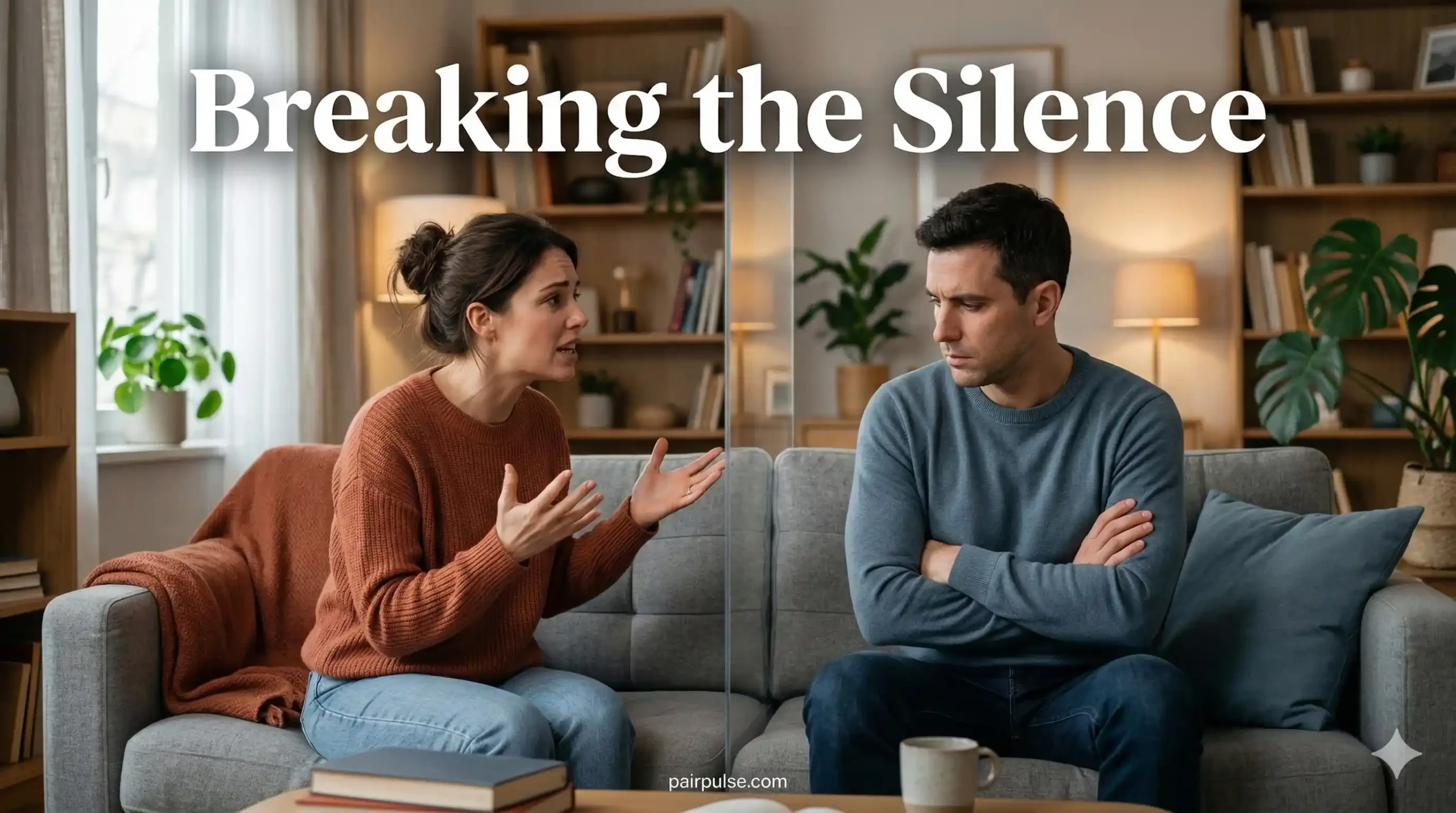
You are sitting on the couch, exhausted after a long day. You start pouring your heart out to your partner about a massive conflict you had at work. You are looking for empathy, a warm hug, and someone to just tell you that your feelings are valid.
Instead, before you even finish your sentence, your partner interrupts. They start listing off five logical ways you should have handled the situation, telling you where you went wrong, and aggressively trying to “fix” the problem.
You instantly feel completely invalidated. You snap back, “You aren’t even listening to me!” They get defensive and reply, “I am literally trying to help you!” In a matter of seconds, a conversation about your bad day has spiraled into a massive fight about your relationship.
If you are reading this on PairPulse today, you know exactly how exhausting it is to talk at a brick wall. Feeling unheard by the person who is supposed to love you the most is one of the loneliest experiences in the world.
But what if I told you that in most cases, your partner isn’t maliciously ignoring you? Today, we are going to dive deep into the psychology of human communication. We will uncover exactly why your words are getting lost in translation, and how you can use the principles of “Radical Communication” to finally be heard, understood, and emotionally validated.
The Psychological Barriers: Why They Stop Listening
Human beings are incredibly complex communicators, and our brains are constantly filtering out information to protect our emotional state. When your partner fails to hear you, it is usually because one of these massive psychological barriers has been triggered.
1. The “Fixer” vs. “Feeler” Disconnect
This is the number one cause of communication breakdown in heterosexual relationships, heavily influenced by societal conditioning.
- The Fixer (Often Male): Men are largely conditioned by society to base their value on their ability to solve problems and provide solutions. When a partner comes to them in distress, their brain immediately goes into “tactical mode.” They think listening is fixing.
- The Feeler (Often Female): Women are often conditioned to seek emotional connection and validation. When they are stressed, they do not want a solution; they want a safe space to process their emotions out loud.
When a Feeler meets a Fixer, disaster strikes. The Feeler feels dismissed and ignored, while the Fixer feels unappreciated and attacked for “just trying to help.”
2. Emotional Flooding (The Amygdala Hijack)
If you are trying to communicate during a heated argument, your partner might literally be biologically incapable of hearing you.
According to renowned relationship researchers at The Gottman Institute, when a discussion becomes too intense, a person can experience “emotional flooding.” Their heart rate spikes above 100 beats per minute, and their brain’s threat-detection center (the amygdala) completely hijacks their nervous system. They enter “fight, flight, or freeze” mode. At this biological stage, the logical part of their brain shuts down. They cannot process your words, your logic, or your pain. They only perceive you as a threat.
If you constantly find yourself screaming just to be heard, you absolutely must master relationship conflict resolution and learn to take a 20-minute timeout before continuing the conversation.
3. The Filter of Past Resentments
If your relationship has a history of unresolved issues, your partner is no longer hearing what you are actually saying today; they are hearing what you said three years ago. If they feel constantly criticized, they will listen defensively, waiting for the attack, rather than listening empathetically to understand your perspective.
What is Radical Communication?
Radical communication is the conscious, intentional practice of stripping away your ego, your defensiveness, and your desire to be “right,” and replacing it with an intense curiosity about your partner’s emotional reality.
It requires extreme vulnerability. You have to stop speaking in accusations (“You never do this”) and start speaking purely from your own emotional core.
Step 1: Declare Your Intent Before You Speak
Before you launch into a story or a complaint, you must give your partner the “instruction manual” for how to listen to you. If you remove the guesswork, you remove the friction.
- If you just want to vent: “Hey, I had a terrible day. I don’t need advice right now, I just really need you to hold me and listen while I vent for ten minutes. Is that okay?”
- If you actually need advice: “I am really struggling with a problem at work and I value your logic. Can I get your advice on how to fix it?”
Step 2: Speak in “I” Statements, Not “You” Statements
When you start a sentence with “You,” your partner’s defensive walls instantly shoot up.
- Toxic: “You never listen to me when I talk about my family.”
- Radical: “I feel really lonely and disconnected when I share stories about my family and I don’t get a response.”
By focusing on modern love languages & communication, you shift the dynamic from an attack to an invitation for intimacy.
Step 3: The Practice of Active Mirroring
According to Psychology Today, one of the most powerful tools in couples therapy is “Active Mirroring.” When your partner tells you something painful, you must repeat back what you heard before you offer your own opinion.
“What I am hearing you say is that you felt completely abandoned when I made plans without asking you. Did I get that right?”
This simple act validates their reality. It proves to them that their words actually landed in your brain.
The Ultimate Test: Do Your Baselines Match?
Sometimes, the inability to communicate isn’t a lack of effort; it is a fundamental mismatch in emotional intelligence and core values.
If you are pouring your heart out, using “I” statements, and reading every psychology book available, but your partner simply dismisses you, rolls their eyes, or refuses to engage, you are fighting a losing battle. You cannot teach someone how to improve emotional intimacy if they are completely unwilling to learn.
Before you burn yourself out trying to force a brick wall to speak, it is crucial to step back and evaluate your baseline connection. Sitting down during a peaceful moment and taking a couple compatibility score test together can be a highly revealing, objective way to see if your communication styles simply require some fine-tuning, or if you are fundamentally speaking two different languages.

Frequently Asked Questions (FAQs)
1. How do I get my partner to open up if they are a completely closed-off person?
Do not interrogate them. Closed-off or “avoidant” partners retreat further when pressured. Create a safe, low-stakes environment. Often, the best conversations happen when you are not making direct eye contact—like while driving in the car together, or going for a walk side-by-side.
2. Is it normal to feel exhausted after trying to communicate?
Yes, absolutely. Radical communication requires massive amounts of emotional energy, especially in the beginning. You are actively rewiring years of bad habits. Give yourself and your partner grace. Take breaks, and reward yourselves for having a healthy, conflict-free discussion.
3. What if I try all these techniques and they still shut me down?
If you are consistently met with stonewalling, contempt, or gaslighting despite your best efforts to communicate clearly and respectfully, it might be time to seek professional couples counseling. If they refuse therapy, you must seriously evaluate whether the relationship is healthy for your long-term mental well-being.
Final Thoughts: The Greatest Gift
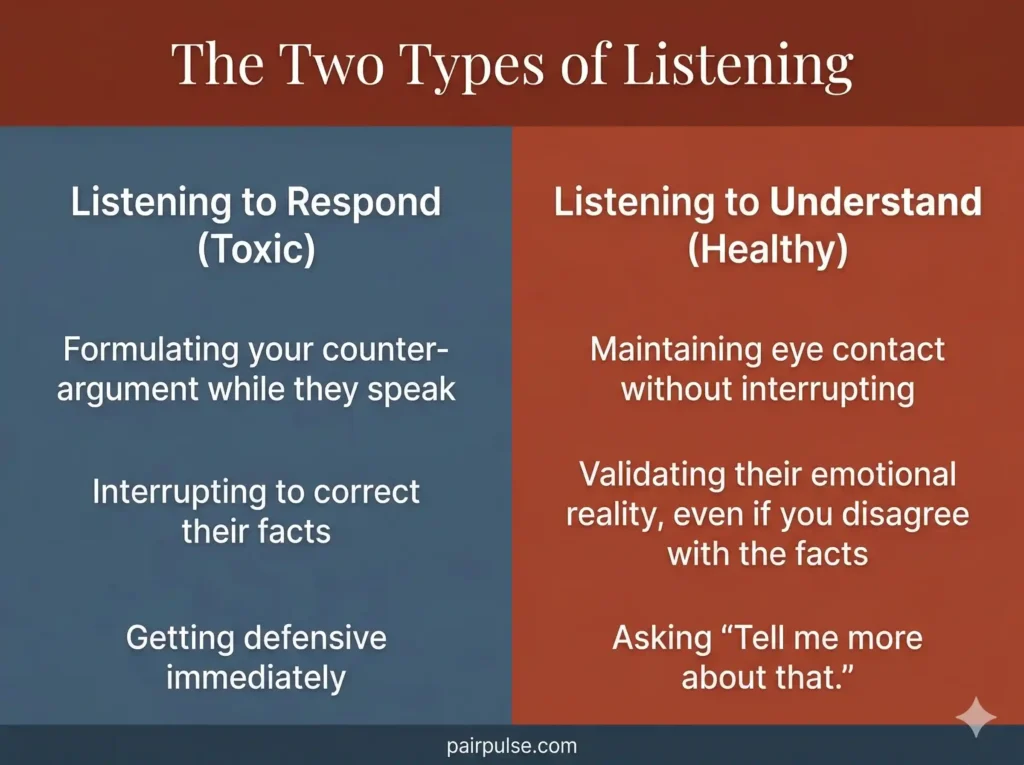
Listening is not a passive activity. It is not simply the act of waiting for your turn to speak.
True, radical listening is the most profound act of love you can offer another human being. It is looking at your partner and saying, “Your inner world matters to me. Your pain is valid, your joy is my joy, and I am entirely present for whatever you need to say.”
The next time your partner comes to you in distress, take a deep breath. Turn away from your screen. Put down the urge to fix their life. Just look them in the eyes, listen to understand, and watch how quickly the walls between you begin to crumble.
What is the biggest communication hurdle in your relationship right now? Have you ever tried the “comfort vs. solutions” question? Share your experiences with the PairPulse community in the comments below!
2 thoughts on “Why Your Partner Doesn’t Hear You: The Complete Psychological Guide to Radical Communication”