
It usually starts with the silence.
They come home, drop their keys, and stare at the TV without seeing it. Or maybe it’s the anger—snapping at the kids for being too loud, complaining about the commute with a venom that feels disproportionate.
Then comes the bomb drop: “I got laid off.” Or perhaps: “I can’t do this anymore. I quit.”
A career crisis is one of the top three stressors a marriage can face (right up there with death and divorce). Why? Because in our modern world, what we do is who we are. When the title is stripped away, your partner isn’t just losing a paycheck; they are experiencing a death of identity.
If you are reading this, you are probably terrified. You are worried about the mortgage, the future, and the person sitting next to you who looks like a stranger.
At PairPulse, we know that generic advice like “just listen” doesn’t cut it when the bank account is draining. In this comprehensive guide, we are going to explore the psychology of professional failure, how to be a partner instead of a “fixer,” and how to navigate this storm without capsizing your relationship.

1. The Anatomy of a Career Crisis: It’s Not Just About the Money
To support your partner, you must first understand what is happening inside their brain.
When a person faces a career crisis—whether it’s a layoff, burnout, or a failed business—they are going through the Grief Cycle.
According to Harvard Business Review, job loss triggers the same neurological pathways as physical pain.
The “Identity Quake”
For many people (especially men, due to societal conditioning), their worth is tied to their ability to provide and produce.
- The Thought Loop: “If I am not an Engineer/VP/Provider, then I am nothing.”
- The Result: They feel shame. And shame is a master of disguise. It looks like anger, withdrawal, or numbness.
Your Role:
You cannot fix their career today. But you can anchor their identity.
Remind them of the roles they haven’t lost.
- “You are still a father.”
- “You are still my husband.”
- “You are still the guy who makes me laugh.”
2. The “Fixer” Trap: Why Your Advice Is Making It Worse
When we see someone we love in pain, our instinct is to Fix It.
- “Have you updated your LinkedIn?”
- “Did you call that recruiter?”
- “Maybe you should take a course.”
You think you are being helpful.
They hear: “You are failing, and you aren’t fixing it fast enough. I don’t trust you to handle this.”
The “Coach vs. Cheerleader” Distinction
- A Coach gives tactical advice and critiques form. (They don’t need a coach right now; they likely have a harsh inner critic doing that job already).
- A Cheerleader stands on the sidelines and says, “I believe in you.”
The Golden Rule:
Never offer unsolicited advice.
Instead, ask the Magic Question:
“Do you want to brainstorm solutions, or do you just want to vent and be heard?”
90% of the time, they just want to vent.
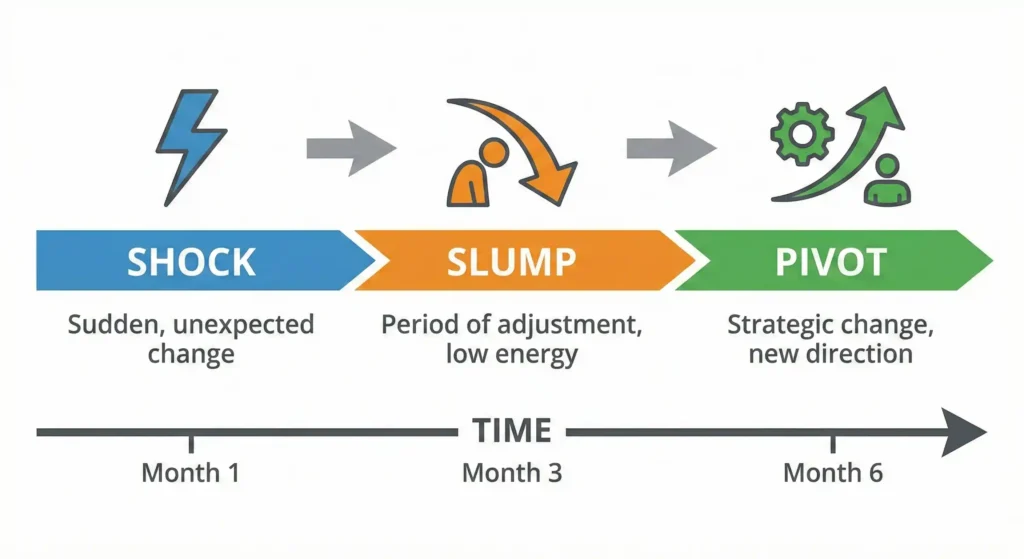
3. The 3 Phases of Support (Timing Is Everything)
You cannot treat Day 1 of a layoff the same as Day 90. The support must evolve.
Phase 1: The Shock (Days 1-14)
This is the Triage phase. They are in survival mode.
- Do: Listen. Cook their favorite dinner. Handle the mental load of the house.
- Don’t: Ask “What’s the plan?” or talk about budget cuts (unless it’s an emergency).
- Script: “I know this is scary. But we are a team. We have survived hard things before, and we will survive this.”
Phase 2: The Slump (Weeks 3-10)
The adrenaline has worn off. The recruiters aren’t calling back. Depression creeps in.
- Do: Encourage routine. “Let’s go for a walk.” “Let’s wake up at 8 AM.”
- Don’t: Nag them about applying for jobs.
- Script: “I noticed you seem down today. Let’s get out of the house for an hour. No job talk allowed.”
Phase 3: The Pivot (Month 3+)
If they are stuck, now is the time for gentle challenges.
- Do: Ask open-ended questions about their direction.
- Don’t: Threaten them.
- Script: “I love you, and I believe in you. But I’m seeing you struggle to make progress. Do you think it’s time to look at a bridge job or a career coach?”
4. Managing Your Own Anxiety (The “Silent” Crisis)
Here is the part nobody talks about: You are freaking out too.
You are worried about the bills. You are resentful that you have to carry the load. You are scared they will never recover.
This is called “Secondary Traumatic Stress.”
If you dump your anxiety on them, they will crumble. They are already carrying a heavy load; they cannot carry yours too.
The “Ring Theory” of Support
Imagine a set of concentric rings.
- Center Ring: The person in crisis (Your Partner).
- Second Ring: You (The Spouse).
- Third Ring: Friends/Family.
The Rule: Comfort IN, Dump OUT.
- You offer comfort IN to the center ring (Partner).
- You dump your stress OUT to the third ring (your mom, your best friend, your therapist).
- Never dump your fear on the person in the center.
Gut Check: Is the financial stress making you question the viability of the marriage? Take our Should I Break Up? Quiz to evaluate if this is a temporary hurdle or a permanent crack in your foundation.
5. The Financial Reality Check: Having the “Scary” Talk
You can’t ignore the bank account forever. But you have to time this talk carefully.
Do not have this conversation late at night or when they just got a rejection email.
The “War Room” Meeting
Schedule a specific time. Bring snacks. Open a spreadsheet.
- Step 1: Total transparency. “Here is what we have in savings.”
- Step 2: The “Runway” calculation. “We can survive for X months without income.”
- Step 3: The Cuts. “Let’s pause Netflix and the gym membership for now.”
Framing is Key:
Use “We” language.
- Bad: “You need to stop spending money.”
- Good: “We need to tighten our belt so we have a longer runway. What expenses do you think we can cut?”
This turns the budget into a strategy, not a punishment.
6. Masculinity, Vulnerability, and the “Provider” Complex
Note: This applies to any partner who identifies as the primary provider, regardless of gender, but is culturally most acute in men.
If your husband or male partner loses his job, he is often battling a deep, evolutionary shame.
Society tells men: Value = Provision.
When he can’t provide, he feels like he has failed as a man.
Signs of the “Shame Spiral”:
- Emasculation (withdrawing from sex/intimacy).
- Irritability (anger is a safer emotion than sadness).
- Hiding out (sleeping late, playing video games).
How to Help:
You need to validate his worth outside of money.
- Initiate intimacy (if you feel up to it). It signals: “I still desire you. You are still powerful to me.”
- Ask for his help with non-monetary things. “Can you help me fix the sink?” “I need your advice on this situation with my friend.”
- This proves to him that he is still useful and needed.

7. When It Turns Toxic: Signs of Depression
A career crisis can easily slide into clinical depression.
According to the Mayo Clinic, situational depression is common after job loss.
Watch for these Red Flags:
- Disrupted sleep patterns (sleeping all day or not at all).
- Significant weight change.
- “Anhedonia” (loss of interest in things they used to love).
- Substance abuse (drinking more to numb the pain).
If you see this, “cheering them up” won’t work. They need professional help.
The Script: “I love you too much to watch you suffer like this. I think this is bigger than just the job. Will you talk to a doctor if I make the appointment?”
8. Frequently Asked Questions (FAQs)
How long should I let them “wallow” before pushing them?
Grief experts suggest that the acute phase lasts about 2-4 weeks. If they haven’t sent a single resume or changed out of pajamas after a month, it’s time for a gentle nudge.
They are refusing to look for work. Is this grounds for divorce?
It depends. Is it depression, or is it a values misalignment? If they are actively refusing to contribute to the partnership for months/years despite your distress, that is a violation of the marital contract.
Should I help them write their resume?
Only if they ask. If you do it for them, you rob them of the agency they need to rebuild their confidence. You can offer to proofread it, but don’t write it.
How do we handle the question “What do you do?” at parties?
This is a dreaded question. Help them script an answer beforehand.
Option: “I’m currently pivoting and looking for the next right challenge.”
Option: “I’m taking a mini-sabbatical to recharge before my next move.”
9. Rebuilding the Future: The “New Normal”
A career crisis often forces a necessary pivot.
Maybe they hated that corporate job anyway. Maybe this is the push they needed to start that business or go back to school.
The “Values” Conversation
Once the shock has subsided, use this as an opportunity to dream.
- “If money wasn’t an issue, what would you actually want to do?”
- “What kind of life do we want to build?”
This turns the crisis into a chrysalis—a painful but necessary stage of transformation.
Thinking about the future? A career shift often changes the dynamics of a relationship. Check your Couple Compatibility Score to see if your long-term goals and work-life balance values are still aligned in this new chapter.
Final Thoughts from Oliver
Watching your partner suffer is one of the hardest things you will do in a relationship. You want to save them, but you can’t.
You are the co-pilot, not the pilot. You can read the map, you can bring the snacks, and you can keep the mood calm in the cockpit. But they have to fly the plane.
Trust in their resilience. Trust in the foundation you built. And remember: This is a chapter, not the whole book.