I was recently reading through a late-night relationship forum when I stumbled upon a confession that completely caught my attention. A woman wrote, “I’ve realized I don’t just fall in love with a person. I fall in love with the love between two people. When I see a couple who is deeply connected, who share inside jokes and a beautiful, synchronized energy, I feel an intense magnetic pull toward them—not as individuals, but as a unit.”
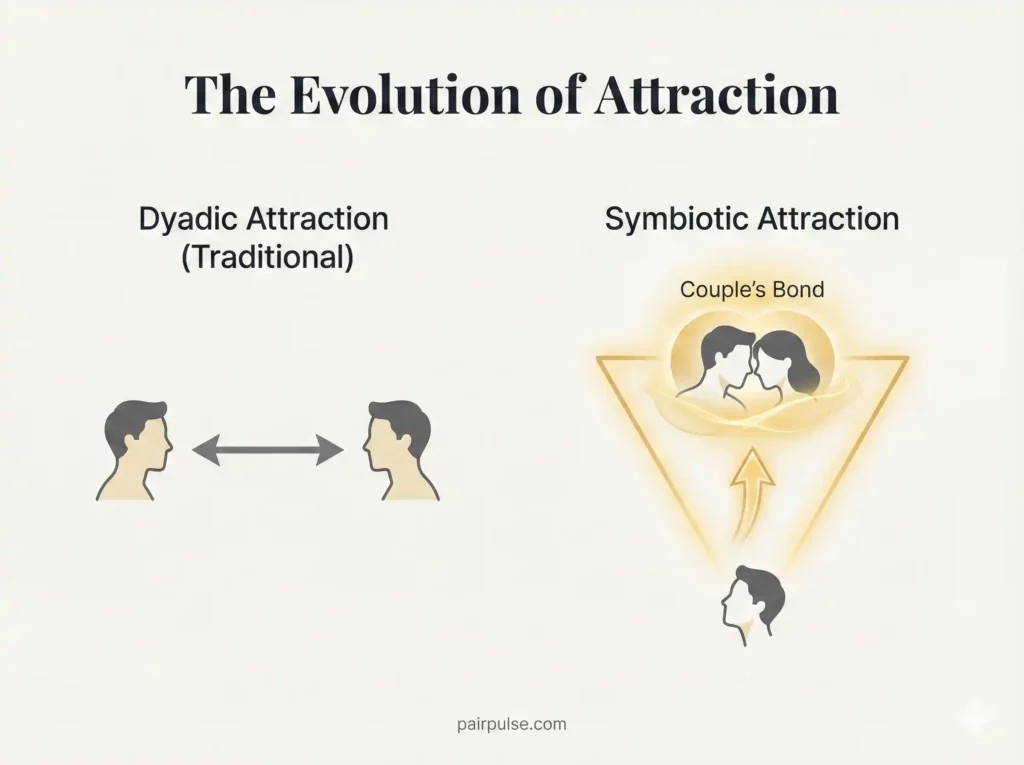
For decades, society has told us that human attraction is a straight line drawn between Point A and Point B. Boy meets girl. Person meets person. We have always viewed romance through a strictly dyadic lens—meaning a connection that exists exclusively between two individuals.
But what happens when your heart, or your physical desire, is drawn to the invisible space between two people? What do you call it when you are attracted to the dynamic, the shared history, and the combined energy of a pre-existing couple?
Welcome to the fascinating, newly defined world of Symbiosexuality.
If you have ever felt an inexplicable attraction to a couple’s shared bond, or if you are a couple who has noticed someone drawn to your relationship’s energy, you are in the right place. Today on PairPulse, I am going to walk you through exactly what this emerging phenomenon means, why it is forcing relationship experts to completely rethink the nature of human attraction, and how to navigate these complex feelings ethically.
Decoding the Definition: What Exactly Is Symbiosexuality?
To understand this concept, we have to look at the root word: Symbiosis. In biology, symbiosis refers to a mutually beneficial relationship between two different organisms living in close physical association. In human relationships, a symbiotic bond is that deep, almost telepathic connection a long-term couple shares. It’s the way they finish each other’s sentences, the way they move around each other in the kitchen, and the profound emotional safety they project to the outside world.
Symbiosexuality is defined as the experience of feeling romantic, emotional, or sexual attraction specifically to the shared energy, dynamic, and existing bond of a couple.
A symbiosexual person isn’t just looking at Partner A and thinking, “They are attractive,” and looking at Partner B and thinking, “They are attractive too.” It is far deeper than that. The attraction is sparked by the relationship itself. The connection is the turn-on. The love they share acts as a magnetic forcefield. If you were to separate that couple and date them individually, the symbiosexual person might actually lose interest, because the magic ingredient—their shared dynamic—is gone.
Why This Phenomenon is Forcing Psychologists to Rethink Attraction
For centuries, the psychological study of love has been incredibly narrow. We have categorized attraction by gender (heterosexuality, homosexuality, bisexuality) or by emotional prerequisites (demisexuality). But all of these orientations still operate on the assumption that attraction is fundamentally a one-on-one experience.
Symbiosexuality is completely disrupting this traditional model. It introduces the reality of triadic attraction.
Leading sociologists and experts studying polyamory and ethical non-monogamy are beginning to realize that human desire is far more expansive than we ever imagined. The rise of this term highlights that humans can be attracted to abstract concepts—like emotional safety, established trust, and relational harmony—just as intensely as they are attracted to physical bodies.
For a symbiosexual individual, entering into the orbit of a healthy, loving couple provides an immediate sense of psychological safety. The couple has already done the hard work of building trust and establishing healthy communication. The symbiosexual person is drawn to the warmth of a fire that has already been built.
The Crucial Difference: Symbiosexuality vs. “Unicorn Hunting”
If you are at all familiar with the ethical non-monogamy (ENM) community, alarm bells might be ringing in your head right now. You might be thinking, “Wait, isn’t this just about couples looking for a third?”
It is absolutely vital that we make a clear distinction here. In the polyamorous community, there is a highly debated practice known as “unicorn hunting.” This is when an established couple (usually heterosexual) seeks out a bisexual woman (the “unicorn”) to join their relationship temporarily, often with strict, unfair rules designed to protect the original couple’s feelings while treating the third person as a disposable accessory.
Symbiosexuality is the exact opposite of this dynamic.
- Unicorn hunting is an action taken by a couple, often rooted in objectification and privilege.
- Symbiosexuality is an internal orientation and emotional experience felt by an individual.
A symbiosexual person is genuinely, organically captivated by the couple’s love. They are not a toy being hunted; they are an individual with a specific, valid pattern of attraction. When a symbiosexual person connects with a couple who practices deeply ethical, respectful non-monogamy, it can create a beautiful, balanced triad where all three people are equally valued.
4 Signs You Might Be Experiencing Symbiosexuality
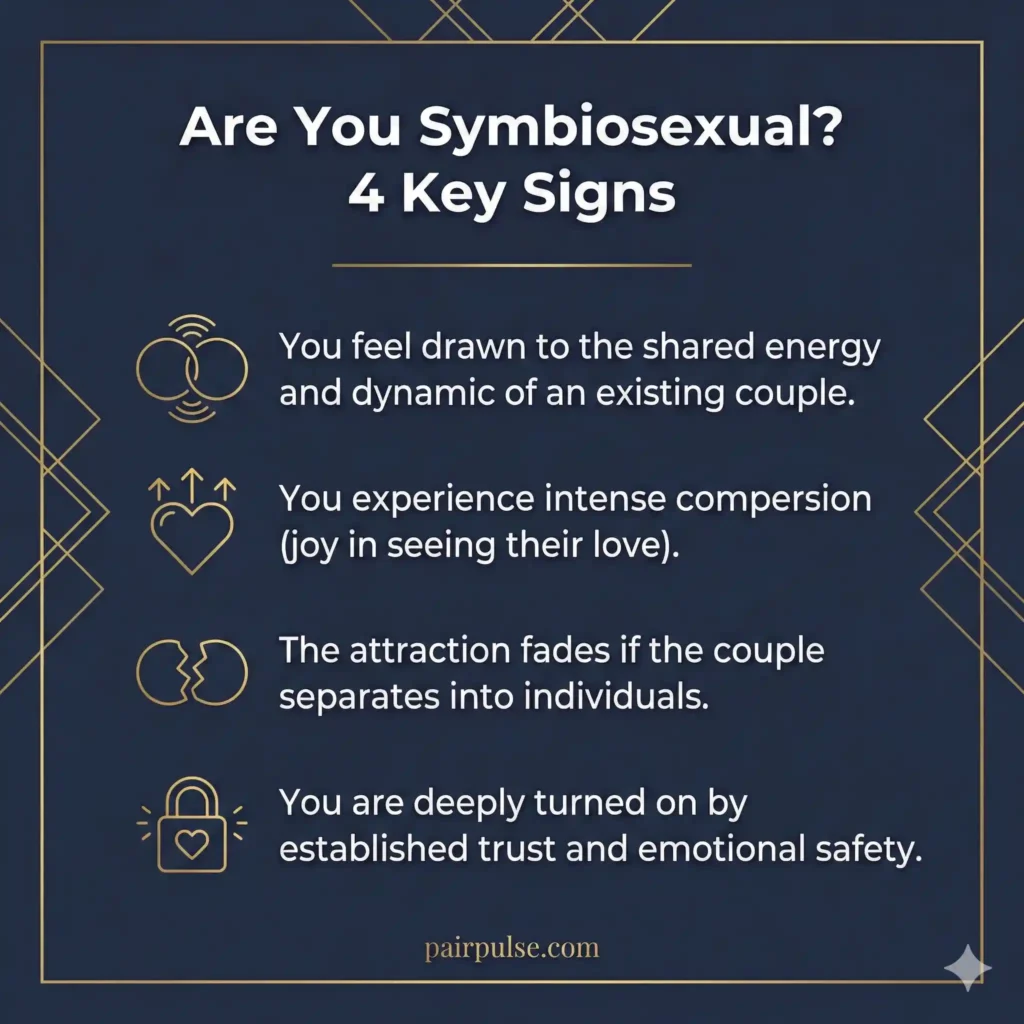
Because this term is so new, many people have experienced these feelings for years without having the vocabulary to describe them. If you are wondering if you might fall somewhere on the symbiosexual spectrum, here are four key signs:
1. You Are Captivated by Relationship Dynamics
When you go out with friends, you find yourself mesmerized by the couples in the group. You observe how they interact, how they resolve minor disagreements, and the silent language they share. You find their stability deeply alluring.
2. Individual Dating Feels Unfulfilling
You might find standard one-on-one dating on apps like Tinder or Bumble to be exhausting and lacking in depth. Starting from scratch with a stranger feels daunting, whereas the idea of stepping into an environment where love is already flowing feels incredibly comforting to you.
3. You Feel “Compersion” Intensely
Compersion is a term often used in the polyamory community; it is essentially the opposite of jealousy. It is the feeling of immense joy you get from seeing someone else experience love or pleasure. If seeing two people deeply in love turns you on or fills your heart with profound warmth, rather than making you feel lonely or jealous, you are experiencing compersion.
4. The Separation Test
As I mentioned earlier, if the couple you are attracted to were to suddenly break up, your attraction to them as individuals would likely diminish significantly. Your desire is anchored to their unity, not just their individual physical traits.
How to Navigate Symbiotic Attraction Ethically
If you realize you are symbiosexual, or if you are a couple navigating someone who is drawn to your relationship, ethical communication is the only way forward. Uncharted territory requires clear maps.
For the Symbiosexual Individual
Please remember that just because you are attracted to a couple’s energy does not mean they are open to expanding their relationship. The vast majority of couples operate under strict monogamy. Unsolicited advances can cause severe distress and cross boundaries. Before acting on any feelings, you must seek out spaces where ethical communication and consent are prioritized, such as ENM or polyamorous communities, where couples are actively and openly seeking triadic connections.
For the Couple
If you are an established couple considering opening your relationship to a third person, you must do the heavy lifting first. You cannot use a symbiosexual person to fix a broken marriage or to spice up a dying bedroom. You must ensure that your foundation is rock-solid, and you must treat any new individual with immense respect, ensuring their emotional needs are met just as fiercely as your own.
Frequently Asked Questions (FAQs)
Is symbiosexuality a recognized sexual orientation?
Currently, it is not listed in clinical diagnostic manuals like the DSM-5. It is considered a modern sociological term and an emerging identity descriptor, primarily gaining traction within sex-positive and ethical non-monogamy communities. As language evolves to better describe human experiences, terms like this help people find communities that understand them.
Can you be symbiosexual and strictly monogamous?
This is a complex question. While you might feel the attraction to a couple’s energy, acting on that attraction fundamentally requires entering into a multi-person dynamic. If you deeply desire a strictly traditional, monogamous, two-person marriage for your own life, your symbiosexual feelings might remain a fantasy or a private turn-on rather than an actionable relationship goal.
Does feeling this way mean there is something wrong with me?
Absolutely not. Human attraction is a vast, beautiful, and highly complex spectrum. Being drawn to love, stability, and deep connection is one of the most natural human instincts. Having the vocabulary to name your experience is the first step toward understanding yourself better and removing any unwarranted shame.
Final Thoughts: Expanding Our Understanding of Love
The emergence of the word symbiosexuality is proof that we are finally starting to realize that love and attraction cannot be stuffed into tiny, rigid boxes. Human beings are incredibly complex, and the ways we connect with one another are constantly evolving.
Whether you identify with this term, or you simply find the psychology behind it fascinating, it serves as a powerful reminder: the energy we create in our relationships is palpable. It is real, it radiates outward, and it has the power to draw people in.
Have you ever experienced this unique kind of attraction, or have you and your partner ever noticed someone drawn specifically to your relationship’s bond? How did you navigate it? Share your thoughts and experiences with the PairPulse community in the comments below—this is a judgment-free zone.