
Every great love story starts the exact same way. You meet someone, the chemistry is absolutely electric, and for the first few months, it feels like you are walking on clouds. They are perfect. You are perfect. The relationship is effortless.
But then, six months or a year down the line, something shifts. The butterflies settle down. You start noticing that they chew a little too loudly, or they are terrible at texting back. Arguments start happening over small, trivial things. Suddenly, you find yourself sitting on the couch wondering, “Where did the magic go? Are we falling out of love?”
If you are reading this on PairPulse today, I want you to take a deep breath. You are not falling out of love; you are simply moving into a new stage.
Human relationships are incredibly complex. They do not remain static. Psychological research shows that every long-term relationship goes through a series of predictable, developmental stages. Understanding these stages is the ultimate cheat code to long-lasting love.
Today, we are going to explore the depths of human relationships by breaking down the 5 universal stages of love. By the end of this guide, you will know exactly which phase you are currently in, and how to successfully navigate the turbulence to reach a lifetime of deep, unshakeable intimacy.
Stage 1: The Honeymoon Phase (The Infatuation)
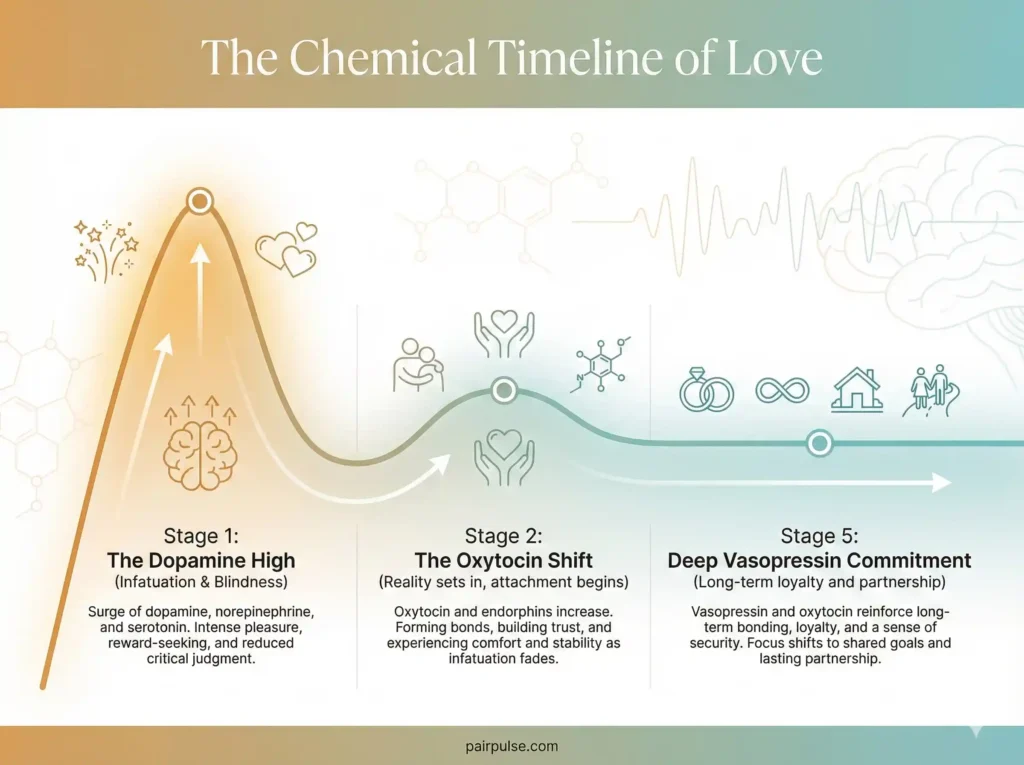
This is the stage everyone is addicted to. When you first fall in love, your brain is flooded with a massive cocktail of dopamine, oxytocin, and endorphins. This neurochemical rush literally alters your perception of reality.
In this stage, your partner has no flaws. You can talk until 4:00 AM, ignore your friends, and neglect your responsibilities just to spend one more hour with them. You focus entirely on your similarities and completely blind yourself to your differences.
- The Goal of this Stage: Enjoy the ride. This phase builds the initial bond that will act as the glue when things get difficult later.
- The Danger: Because your brain is high on hormones, do not make massive life decisions (like getting married or buying a house together) in this stage. Let the chemicals settle first.
Stage 2: The Reality & Doubt Phase
Usually around the 6-month to 1-year mark, the dopamine wears off. You wake up one morning, look at your partner, and the rose-tinted glasses fall off. Welcome to reality.
In this stage, the biological high fades, and you start seeing your partner as a flawed human being. You notice their annoying habits. You realize that you actually have different political views, or different ways of handling stress.
This is the stage where doubt creeps in. You might start asking yourself if you made a mistake. If you are struggling to communicate, you have to actively learn how to improve emotional intimacy without relying solely on physical chemistry.
- The Goal of this Stage: Learn how to communicate your actual needs. Stop pretending to be the “perfect” partner and start being your authentic self.
Stage 3: The Power Struggle (The Disillusionment)
If you survive the reality phase, you enter the hardest stage of any relationship: The Power Struggle.
This is the make-or-break stage. As both of you try to re-establish your individual identities and boundaries, conflict becomes inevitable. Arguments about money, family, and future plans surface. You try to change your partner to fit your ideal image, and they try to change you. Resentment can build quickly here.
This is the stage where most breakups occur. If a major betrayal happens during the power struggle, it requires immense, painful work to rebuild trust after a lie.
If you are currently trapped in this phase and feeling completely exhausted by the constant friction, it is deeply important to evaluate if the relationship is simply going through growing pains, or if it has become toxic. Taking an objective Should I Break Up Quiz can help you step back from your emotions and look at the core compatibility of your partnership.
- The Goal of this Stage: Learn healthy conflict resolution. Stop viewing arguments as a “win/lose” battle against your partner, and start viewing them as “us vs. the problem.”
Stage 4: The Decision & Acceptance Phase
If you navigate the power struggle successfully, something beautiful happens. You enter the Acceptance Phase.
In this stage, you finally give up the fantasy of a “perfect” partner. You look at the person in front of you—with all their quirks, their emotional baggage, and their flaws—and you make a conscious decision to love them anyway. You no longer try to change them.
The relationship becomes a safe harbor. You understand their triggers, and they understand yours. The intense passion of the honeymoon phase is replaced by a deep, profound sense of peace and security. You know that even if you have a terrible argument, neither of you is going to pack your bags and leave.
If you are wondering if your partner is truly the one you want to spend the rest of your life with, this is the stage where taking a couple compatibility score test actually yields the most accurate results, because you are finally answering the questions as your true, unmasked selves.

Stage 5: Deep, Unconditional Commitment
This is the pinnacle of human connection. You have weathered the storms, you have seen each other at your absolute worst, and you have chosen each other anyway.
In this stage, you operate as a true team. You support each other’s individual dreams while building a shared vision for the future. The physical intimacy might not be as frantic as Stage 1, but it is deeply emotional, comforting, and intensely vulnerable.
This is where true love exists. It is not a feeling that happens to you; it is an action you choose every single day.
Frequently Asked Questions (FAQs)
Can you go backwards in the relationship stages?
Yes, absolutely. Relationships are not strictly linear. A major life event—like having a baby, losing a job, or moving to a new city—can easily throw a couple from the Acceptance Phase right back into the Power Struggle. The key is recognizing the shift and using your established communication tools to work through it again.
My partner and I never fight. Does that mean we skipped the Power Struggle?
Not necessarily. While constant screaming matches are unhealthy, a complete lack of conflict is often a red flag. It usually means one or both partners are suppressing their true needs to keep the peace (often seen in avoidant or people-pleasing personalities). Healthy couples argue; they just argue respectfully.
How long does the Honeymoon Phase actually last?
Neurologically and psychologically, the honeymoon phase typically lasts anywhere from 6 months to 2 years. Enjoy it while it is here, but do not panic when it ends. The end of the honeymoon phase is not the end of love; it is the beginning of real intimacy.
Final Thoughts: The Beauty of the Journey
Exploring the depths of a human relationship is not for the faint of heart. It requires immense bravery, vulnerability, and the willingness to look at your own flaws just as closely as you look at your partner’s.
If you are currently in the messy middle—the doubt, the power struggle, the endless compromises—please know that it is completely normal. Do not throw away a potentially beautiful lifelong partnership just because it stopped being easy. The most breathtaking views always come after the hardest climbs.
Embrace the stage you are in, keep choosing your partner every single day, and watch as your love transforms into something unbreakable.
Which stage do you think you and your partner are currently navigating? What has been your biggest relationship challenge so far? Share your experiences with the PairPulse community in the comments below!