Let’s dismantle the biggest myth in modern romance right now: Happy couples do not fight. This is entirely false. In fact, if you and your partner never argue, it is usually not a sign of perfect harmony; it is often a massive red flag. A complete lack of conflict usually means one or both partners are entirely suppressing their true needs and emotions just to “keep the peace.” Over time, that suppressed emotion turns into deep, toxic resentment.
If you are reading this on PairPulse today, I want to reassure you that arguing with your partner is a normal, healthy part of combining two separate lives. You have different upbringings, different triggers, and different ways of viewing the world. Friction is absolutely inevitable.
The difference between a couple that lasts fifty years and a couple that breaks up after a year isn’t the absence of conflict; it is exactly how they handle the conflict.
Today, we are taking a deep dive into relationship conflict resolution. I am going to walk you through the psychological, expert-backed strategies to de-escalate fights, communicate your anger safely, and actually use your arguments to build a much deeper, unbreakable bond.
Phase 1: The Pause (De-escalating the Nervous System)
When your partner says something that triggers you, your brain literally perceives it as a physical threat. Your amygdala (the brain’s alarm system) takes over, flooding your body with adrenaline and cortisol. You enter “fight or flight” mode.
When your heart rate goes over 100 beats per minute during an argument, your prefrontal cortex—the logical, rational part of your brain—completely shuts down. You literally lose the biological ability to be reasonable. This is when people say incredibly hurtful things they don’t actually mean.
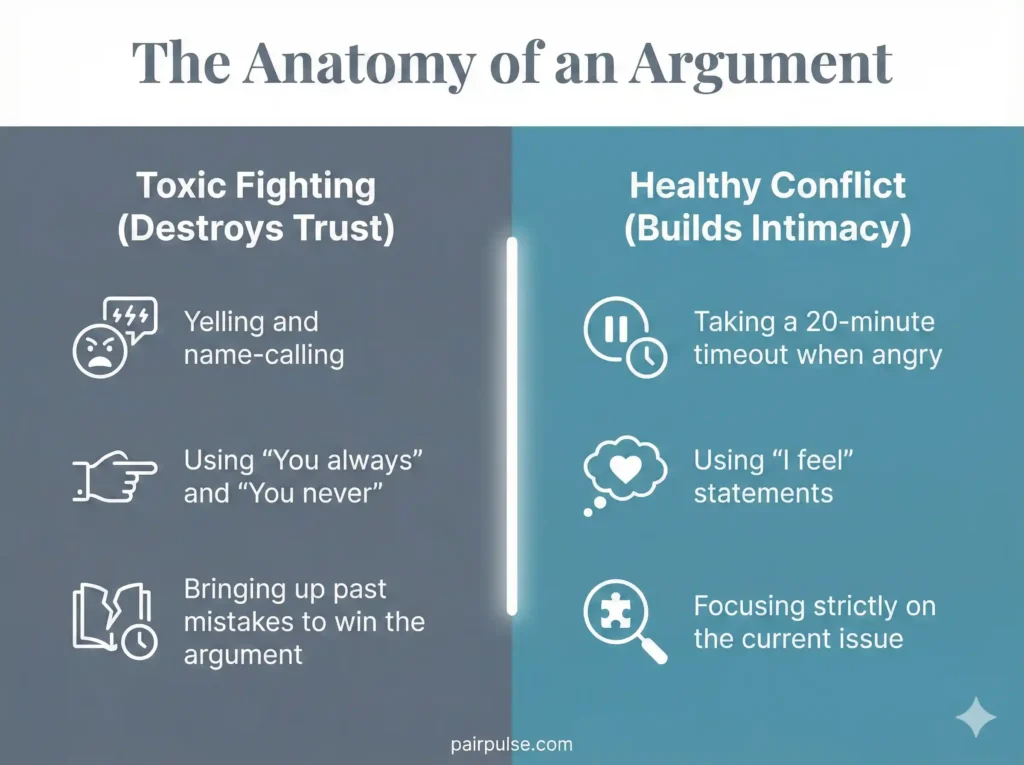
The 20-Minute Rule
If you feel your blood boiling, your voice raising, and your chest tightening, you must hit the pause button.
- What to say: “I am getting too overwhelmed right now and I don’t want to say something I regret. I need a 20-minute break to calm down, but I promise we will finish this conversation when I get back.”
- What to do: Physically leave the room. Go for a walk, listen to a podcast, or take a shower. Do not use this time to replay the argument in your head and build up more anger. You must actively soothe your nervous system before you return to the conversation.
Phase 2: Rules of Fair Fighting
When you return to the conversation with a calm nervous system, you have to abide by the rules of fair fighting. If you want to actually resolve the issue, these three behaviors are absolutely non-negotiable.
1. Eliminate “Always” and “Never”
When you say, “You NEVER help me around the house,” or “You ALWAYS interrupt me,” your partner’s brain immediately goes on the defensive. They will stop listening to your actual pain and instead focus on proving you wrong by pulling up that one time they did the dishes three weeks ago.
- The Fix: Be hyper-specific about the current situation. “I felt really overwhelmed tonight when I had to cook and clean the kitchen by myself.”
2. Use “I” Statements Instead of “You” Statements
A “You” statement feels like an attack: “You are being so selfish right now.” An “I” statement focuses on your internal emotional experience: “I feel incredibly lonely and unsupported when my schedule isn’t considered.” It is very hard for a partner to argue with how you feel. When you focus on your own emotions, it invites empathy rather than defensiveness.
3. Do Not Bring Up the Past
Stick to the current issue. If you are arguing about holiday plans, do not suddenly bring up a mistake they made in 2018. “Kitchen-sinking” (throwing every past grievance into the current fight) makes the argument impossible to resolve. Deal with one fire at a time.
Phase 3: Finding the Root Cause
Here is a massive psychological secret about relationships: You are almost never actually fighting about the dishes.
If you are having a massive blowout over a spoon left in the sink, the fight is not about the spoon. The spoon is simply the breaking point for an unmet emotional need.
- The fight about the dishes is actually about a lack of respect and feeling unappreciated.
- The fight about them being late is actually about a fear of abandonment and feeling like you aren’t a priority.
To truly resolve a conflict, you have to stop arguing about the surface-level trigger and start addressing the underlying emotional wound. When both partners feel safe enough to expose their real vulnerabilities, that is when you truly learn how to improve emotional intimacy.
Phase 4: The Art of the Repair Attempt
Relationship researcher Dr. John Gottman states that successful couples are masters of the “repair attempt.”
A repair attempt is any statement or action—silly or serious—that prevents negativity from escalating out of control. It is essentially a white flag. It could be a small joke in the middle of a tense moment, a gentle touch on the arm, or simply saying, “I know we are angry right now, but I still love you.”
When your partner makes a repair attempt, you must accept it. Do not swat away their olive branch just because you want to stay angry for a little bit longer. Accepting a repair attempt doesn’t mean the argument is over; it simply means you are agreeing to keep the conversation emotionally safe.
Knowing When the Conflict is Toxic
While arguing is normal, constant, soul-crushing conflict is not. There is a massive difference between a passionate disagreement and emotional abuse.
If your arguments regularly feature name-calling, character assassinations, stonewalling (completely ignoring you for days), or if you are constantly catching them in deception and struggling with rebuilding trust after a lie, you are dealing with a highly toxic dynamic.
If you feel completely depleted by the constant fighting and are questioning your reality, stepping back is crucial. Taking an objective, expert-backed Should I Break Up Quiz can help you clearly evaluate if your relationship conflicts are normal growing pains, or severe signs of fundamental incompatibility.
Furthermore, if your conflicts always seem to stem from vastly different ways of living and communicating, taking a couple compatibility score test together during a peaceful moment can help both of you understand your baseline differences before the next fight even starts.
Frequently Asked Questions (FAQs)
1. Should we never go to bed angry?
This is actually outdated advice. If it is 1:00 AM, you are both exhausted, and the argument is going in circles, forcing a resolution will only make things worse. Sleep deprivation destroys emotional regulation. It is perfectly healthy to say, “I love you, but we are too tired to solve this right now. Let’s get some sleep and talk about it over coffee tomorrow morning.”
2. Who should apologize first?
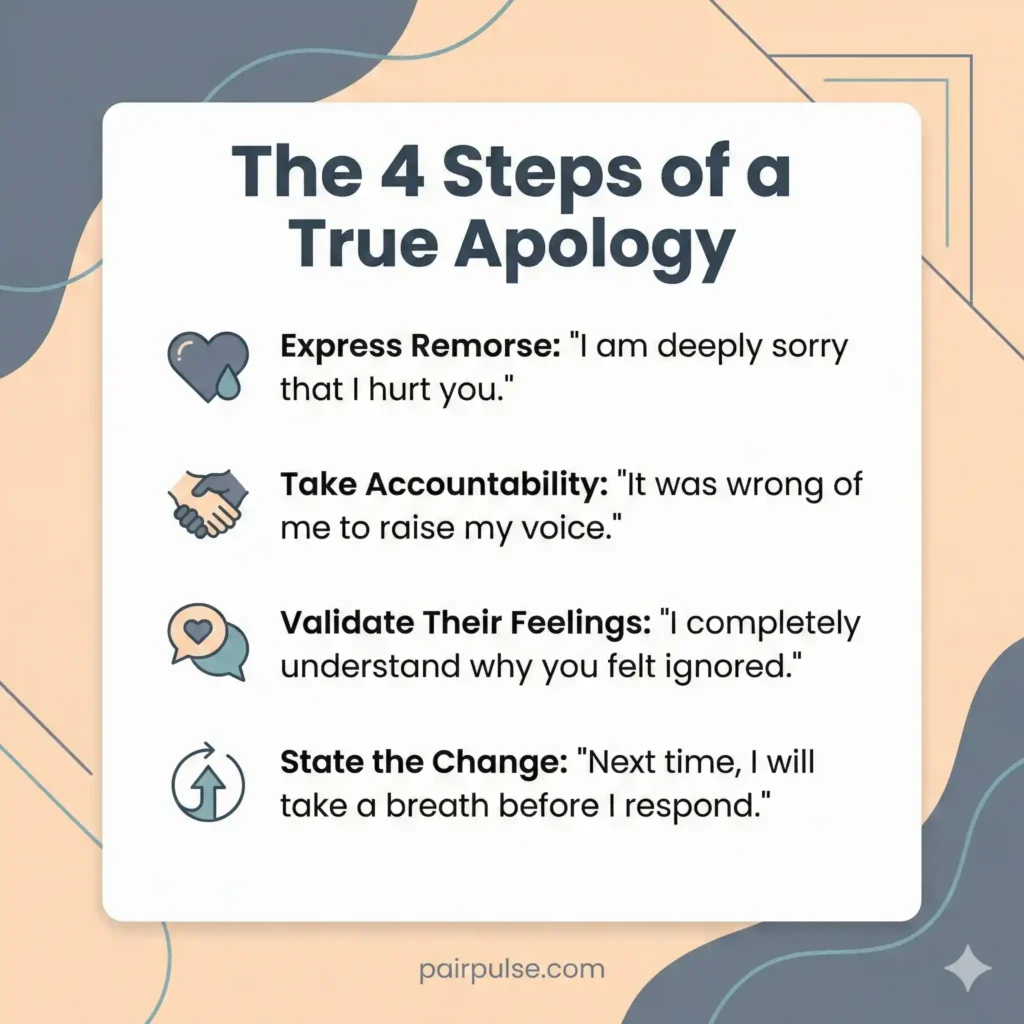
The person who recognizes the destructive cycle first should be the one to break it. Apologizing first is not a sign of weakness or an admission that you are 100% wrong; it is a sign of immense emotional maturity. It shows that you value the connection more than your own ego.
3. What if my partner refuses to communicate and just shuts down?
This is called “stonewalling,” and it is often a trauma response to feeling completely overwhelmed. Do not chase them or yell at them to talk to you. Give them space. Say, “I see you are overwhelmed. I am going to give you some time, but I need us to revisit this tonight.” If stonewalling is a constant, unyielding pattern, couples therapy is highly recommended.
Final Thoughts: Us Against the Problem
At the end of the day, conflict resolution is simply a mindset shift.
When you are in the heat of a fight, it is so easy to view your partner as the enemy. You want to win the argument, prove your point, and make them see how wrong they are. But in a relationship, if one person “wins” the fight and the other person loses, the relationship as a whole takes a massive loss.
You have to shift your perspective. It is never “You vs. Your Partner.” It is always “You and Your Partner vs. The Problem.”
When you approach conflict as teammates trying to solve a puzzle together, the anger dissipates, the empathy returns, and the very arguments that used to tear you apart will be the exact moments that build your deepest trust.
What is the most effective communication rule you and your partner use during an argument? Share your best conflict resolution tips with the PairPulse community in the comments below!
1 thought on “How to Resolve Relationship Conflict Without Damaging the Bond”