
For centuries, the default blueprint for romantic relationships has been incredibly rigid: You meet one person, you fall in love, you commit to them exclusively, and you stay together until the end of time.
But as modern society evolves, so does our understanding of human psychology and love. Today, a rapidly growing number of couples are realizing that the traditional blueprint simply doesn’t fit their emotional or physical needs. They are stepping outside the boundaries of traditional monogamy and exploring a completely different relationship landscape: Polyamory.
If you are reading this on PairPulse today, you might be curious about opening up your current relationship, or perhaps you are just trying to understand a concept that is gaining massive mainstream traction.
Polyamory is not about cheating, it is not a “free-for-all,” and it is certainly not an easy fix for a broken marriage. It is a highly complex, intentional, and deeply communicative way of living. Today, we are going to explore the psychology of ethical non-monogamy, break down the core types of polyamorous relationships, and reveal what it actually takes to love multiple people successfully.
What is Polyamory (And What is it Not)?
Polyamory translates literally from Greek and Latin roots to mean “many loves.” It falls under the broader umbrella of Consensual Non-Monogamy (CNM).
According to research published by the American Psychological Association (APA), approximately 4% to 5% of adults in the USA are currently involved in some form of consensual non-monogamy.
The absolute core of polyamory is consent and transparency. It is the practice of having, or being open to having, multiple romantic or sexual relationships at the same time, with the full knowledge and enthusiastic consent of everyone involved.
What it is NOT:
- It is not cheating: Cheating is rooted in deception, secrecy, and a violation of trust. Polyamory is rooted in radical honesty.
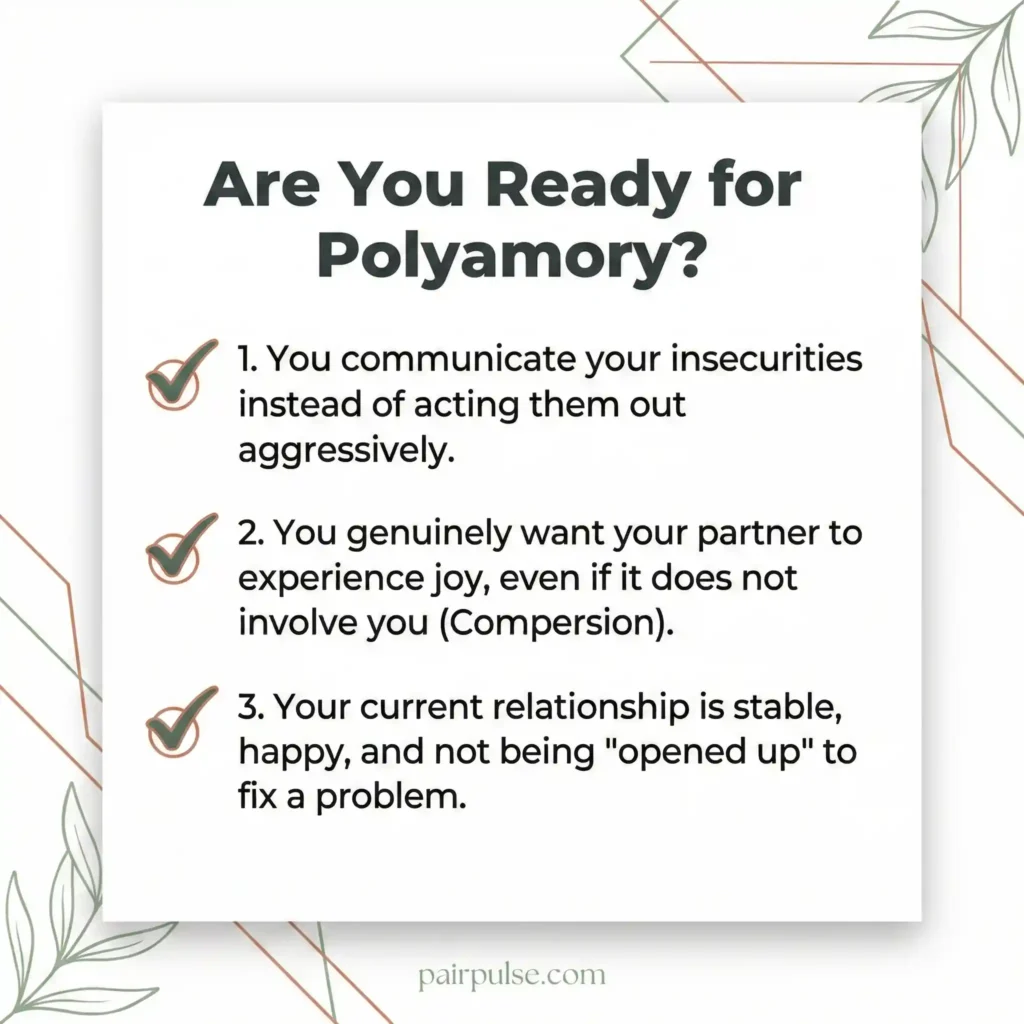
- It is not a “band-aid”: Opening up a failing relationship to “save” it will only accelerate the breakup. Polyamory requires an incredibly strong, secure foundation.
- It is not polygamy: Polygamy is the practice of being legally married to multiple spouses (which is illegal in the US). Polyamory is about romantic connections, not necessarily legal marriages.
The Core Types of Polyamorous Relationships
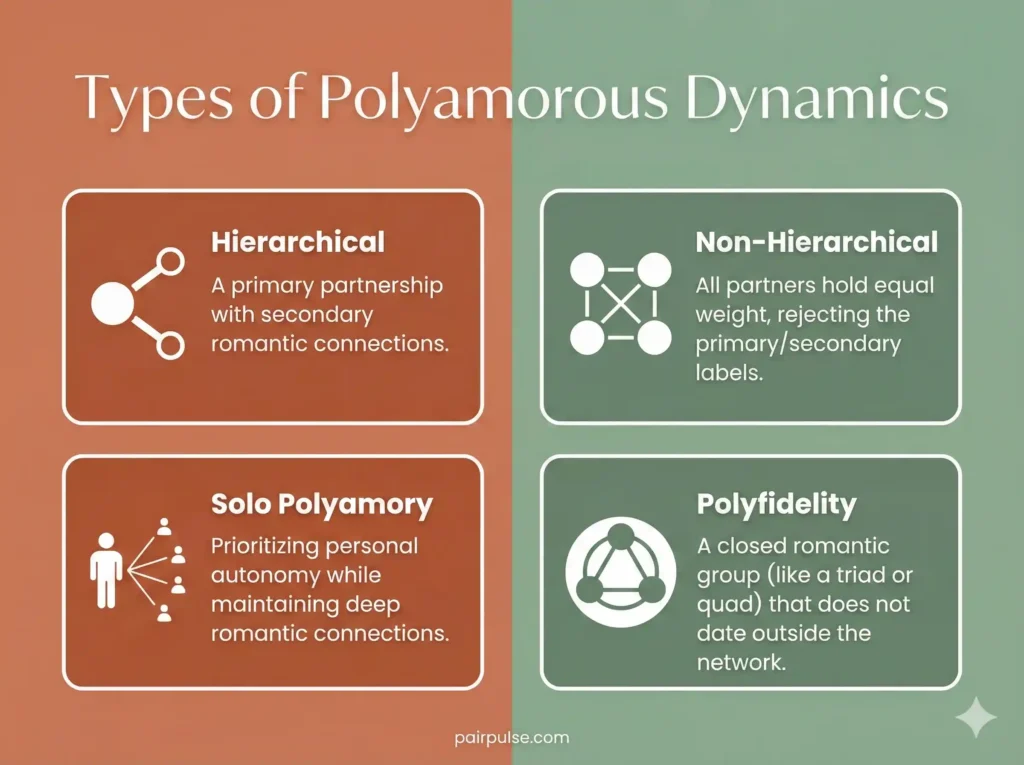
There is no “one size fits all” way to be polyamorous. Just like monogamous relationships, every polyamorous dynamic (often called a “polycule”) is entirely unique. Here are the most common relationship types:
1. Hierarchical Polyamory
In this structure, there is a clear “Primary” relationship (often a married couple or a couple living together) and one or more “Secondary” relationships.
- The Dynamic: The primary partners prioritize their shared life—finances, co-parenting, and major life decisions. Secondary partners are deeply loved and valued, but they do not share the same level of structural entanglement.
2. Non-Hierarchical (Egalitarian) Polyamory
In this model, the concept of ranking partners is entirely rejected.
- The Dynamic: No single relationship is given automatic priority over another. Every partner has an equal voice, and the individual’s time and resources are distributed organically based on need and connection, rather than a pre-defined “primary” status.
3. Solo Polyamory
Solo polyamorists view themselves as their own primary partner.
- The Dynamic: They seek deep, committed romantic relationships with multiple people, but they intentionally choose to avoid the traditional milestones of the “relationship escalator” (e.g., they usually do not want to live with partners, merge finances, or get married). They deeply value their autonomy.
4. Polyfidelity (Closed Dynamics)
This is essentially a closed group relationship.
- The Dynamic: It could be a triad (three people) or a quad (four people) where all members are romantically involved with each other, or at least committed to the group. The key here is “fidelity” to the group—they do not seek outside sexual or romantic partners beyond their established polycule.
The Psychology of Jealousy: Male vs. Female Perspectives
The number one question polyamorous people get asked is: “Don’t you get jealous?”
The answer is yes. Jealousy is a universal human emotion, but polyamorous people choose to process it differently. Instead of viewing jealousy as a reason to control their partner, they view it as an internal alarm bell pointing to an unmet personal need.
Interestingly, studies from institutions like The Kinsey Institute suggest that men and women often process non-monogamous jealousy through different psychological lenses due to evolutionary conditioning.
- Male Psychology: Men often experience sharper jealousy regarding physical or sexual infidelity, deeply rooted in evolutionary fears of competition and paternity. In polyamory, a man must do intense internal work to decouple his ego and masculinity from his partner’s sexual autonomy.
- Female Psychology: Women frequently experience more intense jealousy regarding emotional infidelity or the diversion of resources/time. For a woman navigating polyamory, the fear is rarely just physical; it is often the fear of being emotionally replaced.
The ultimate goal in polyamory is achieving Compersion. Compersion is the exact opposite of jealousy; it is the feeling of genuine joy and warmth you experience when you see your partner happy and thriving with someone else.
The Golden Rules of Ethical Non-Monogamy (ENM)
If you are considering opening up your relationship, you must be prepared for an intense emotional bootcamp. You cannot simply rewrite the rules of romance overnight.
1. Radical, Brutal Honesty
In monogamy, you can sometimes get away with sweeping small resentments under the rug. In polyamory, suppressed emotions will instantly destroy the dynamic. You must actively master how to improve emotional intimacy by voicing your insecurities, your fears, and your boundaries without blaming your partner.
2. Boundaries vs. Rules
There is a massive psychological difference between a rule and a boundary.
- A Rule tries to control your partner’s behavior: “You are not allowed to text your other partner after 9:00 PM.” (This breeds resentment).
- A Boundary dictates your own behavior to protect your peace: “I need my evenings to be phone-free, so I won’t be engaging in text conversations after 9:00 PM.” (This breeds safety).
3. Master Conflict Resolution
When multiple people are involved, the potential for misunderstandings multiplies exponentially. You and your primary partner must have rock-solid relationship conflict resolution skills. If you yell, stonewall, or get defensive when triggered, polyamory will be an incredibly painful experience for everyone involved.
How Do You Know If It’s Right For You?
Polyamory is a relationship orientation. Some people are naturally wired for it, while others are fundamentally, biologically wired for strict monogamy. Neither is “better” or more enlightened than the other.
Before introducing a third party into your dynamic, it is highly recommended to assess your foundational alignment. Taking a couple compatibility score quiz together can act as a fantastic, low-pressure conversation starter to see if your core values regarding autonomy, communication, and jealousy actually align.
When to Walk Away
If your partner is pressuring you into a polyamorous dynamic and you are only agreeing out of fear of losing them, stop immediately. Consenting under duress is not ethical non-monogamy; it is emotional manipulation.
If you are suffering through a one-sided open relationship that is destroying your mental health, it might be time to take an objective Should I Break Up Quiz. You deserve a relationship structure that makes you feel safe, secure, and entirely valued, whether that involves one partner or several.
Frequently Asked Questions (FAQs)
Is polyamory legal in the United States?
Yes. Having multiple consensual romantic or sexual partners is completely legal. However, polygamy (being legally married to more than one person at the same time) is illegal in all 50 states. Polyamorous people only hold one legal marriage license, even if they consider themselves married to multiple people in spirit.
How do polyamorous people have enough time for multiple partners?
Time management is often considered the most difficult part of polyamory! It requires meticulous scheduling (many polycules use shared Google Calendars) and a massive shift in expectations. It means prioritizing the quality of time over the sheer quantity of time.
Do polyamorous relationships last?
Yes, absolutely. While some polyamorous relationships end (just like many monogamous ones do), many polycules stay together, raise children together, and buy homes together for decades. The success of the relationship is based on communication and mutual respect, not the number of people involved.
Final Thoughts: Designing Your Own Love Story
Exploring polyamorous relationship types requires immense bravery. It asks you to strip away all the societal expectations you were raised with and build a custom relationship from the ground up.
It is not an easy path. It requires facing your deepest insecurities, communicating until you are exhausted, and completely rewiring your understanding of love. But for those who are willing to do the internal work, polyamory offers a beautiful, multifaceted landscape where love is not a finite resource to be guarded, but an infinite capacity to be shared.
Whether you choose a life of dedicated monogamy or a life of ethical non-monogamy, the most important rule remains the same: choose the structure that brings you the most profound peace.
Are you currently navigating a polyamorous dynamic, or considering opening up your relationship? What has been your biggest challenge or greatest joy? Share your experiences with the PairPulse community in the comments below!
2 thoughts on “The Ultimate Guide to Polyamory: Types, Rules, and Relationship Psychology”