Imagine this scenario: You have been with your partner for three years. You love them deeply, you share a home, and you are planning a future together. You are entirely fulfilled by this single connection. Then, one Tuesday evening, your partner sits you down and drops a bombshell: “I love you, but I have realized I am polyamorous. I want to start seeing other people, but I still want to stay with you.”
Your stomach drops. You do not want to see other people. You only want them. But you are suddenly faced with an impossible choice: agree to a relationship structure that shatters your sense of safety, or lose the person you love entirely.
If you are reading this on PairPulse today, you are likely navigating the incredibly complex, often agonizing world of One-Sided Polyamory (clinically referred to as a “Mono-Poly” relationship).
This is the most difficult relationship dynamic to sustain in modern dating. While a standard polyamory guide will tell you that ethical non-monogamy is built on equal transparency, a mono-poly dynamic is inherently unbalanced. Today, we are going to dive deep into the psychology of one-sided polyamory, explore why it happens, and brutalize the myths to uncover whether this dynamic can actually survive long-term.
What is a Mono-Poly Relationship?
A mono-poly relationship occurs when one partner identifies as polyamorous (desiring multiple romantic or sexual connections) and the other partner identifies as strictly monogamous (desiring exclusivity).
To truly understand this dynamic, we must divide it into two very distinct categories. The survival of the relationship depends entirely on which category you fall into.
Type 1: The “Complementary” Mono-Poly Dynamic (Extremely Rare)
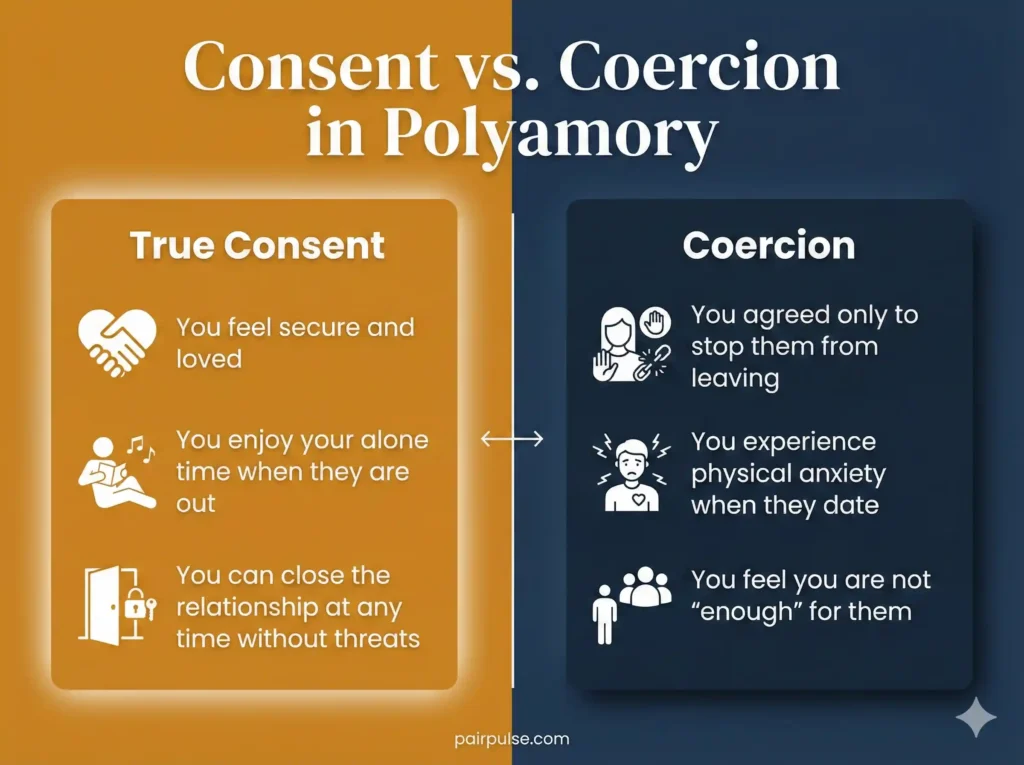
In this scenario, the monogamous partner is enthusiastically okay with the arrangement. They do not feel coerced. This usually happens in highly specific circumstances:
- Mismatched Libidos: One partner might be asexual, or have a significantly lower sex drive, and feels profound relief that their partner can have their physical needs met elsewhere.
- Extreme Introversion: The monogamous partner might require vast amounts of alone time. They enjoy having the house to themselves while their polyamorous partner is out on a date.
- Compersion: The monogamous partner genuinely experiences “compersion” (joy derived from seeing their partner happy with someone else) without triggering their own insecurities.
Type 2: The “Coerced” Mono-Poly Dynamic (Highly Common)
This is where the psychological trauma begins. The monogamous partner does not want the relationship to open. They agree to it solely under duress, driven by an intense fear of abandonment. They suffer in silence, waiting at home with crippling anxiety while their partner is out dating. This is not ethical non-monogamy; it is a hostage situation disguised as open-mindedness.
The Psychological Toll: Two Different Realities
A coerced mono-poly relationship creates a massive psychological divide. Because men and women process attachment and jealousy differently, the emotional toll is severe on both sides of the equation.
The Monogamous Partner’s Reality: A Crisis of Self-Worth
For the monogamous partner, the arrangement often triggers severe attachment anxiety. The human brain is hardwired to seek safety. When the monogamous partner stays home while the polyamorous partner goes on a date, their nervous system registers it as a direct threat.
- The “Not Enough” Fallacy: They constantly battle the internal narrative of, “If I was prettier, smarter, or better in bed, they wouldn’t need anyone else.” * Hyper-Vigilance: They begin analyzing every text their partner sends, tracking their location, and experiencing a spike in cortisol (the stress hormone) whenever their partner leaves the house.
The Polyamorous Partner’s Reality: The Burden of Guilt
The polyamorous partner is not immune to the psychological toll. If they have a conscience, they can see the pain they are causing.
- The Guilt Cycle: They want to enjoy their secondary relationships, but the joy is immediately crushed by the guilt of returning home to a crying, anxious primary partner.
- The “Villain” Complex: They often feel misunderstood. They genuinely love their monogamous partner and do not want to hurt them, but they also feel completely suffocated trying to repress their polyamorous orientation.
The Red Flags: Is It Just Cheating With Permission?
This is the hardest truth to swallow. In many cases of one-sided polyamory, the partner requesting the open relationship is not actually polyamorous. They are simply too cowardly to break up.
According to psychological guidelines from organizations like the American Psychological Association (APA), healthy relationships require mutual respect and shared goals. If your partner has a history of deceit, and suddenly asks for a mono-poly dynamic after they have already been caught crossing boundaries, they are weaponizing the concept of polyamory.
If they have already broken your trust, and you are trying to figure out how to deal with infidelity by retroactively making it an “open relationship,” you are setting yourself up for emotional destruction. You cannot build a complex, multi-partner dynamic on a foundation of lies.
Furthermore, if you dive into why polyamory fails, you will see that a phenomenon known as “poly-bombing” (dropping the polyamory ultimatum on a long-term monogamous partner) is one of the most destructive trends in modern dating.
Survival Guidelines: Can You Make It Work?
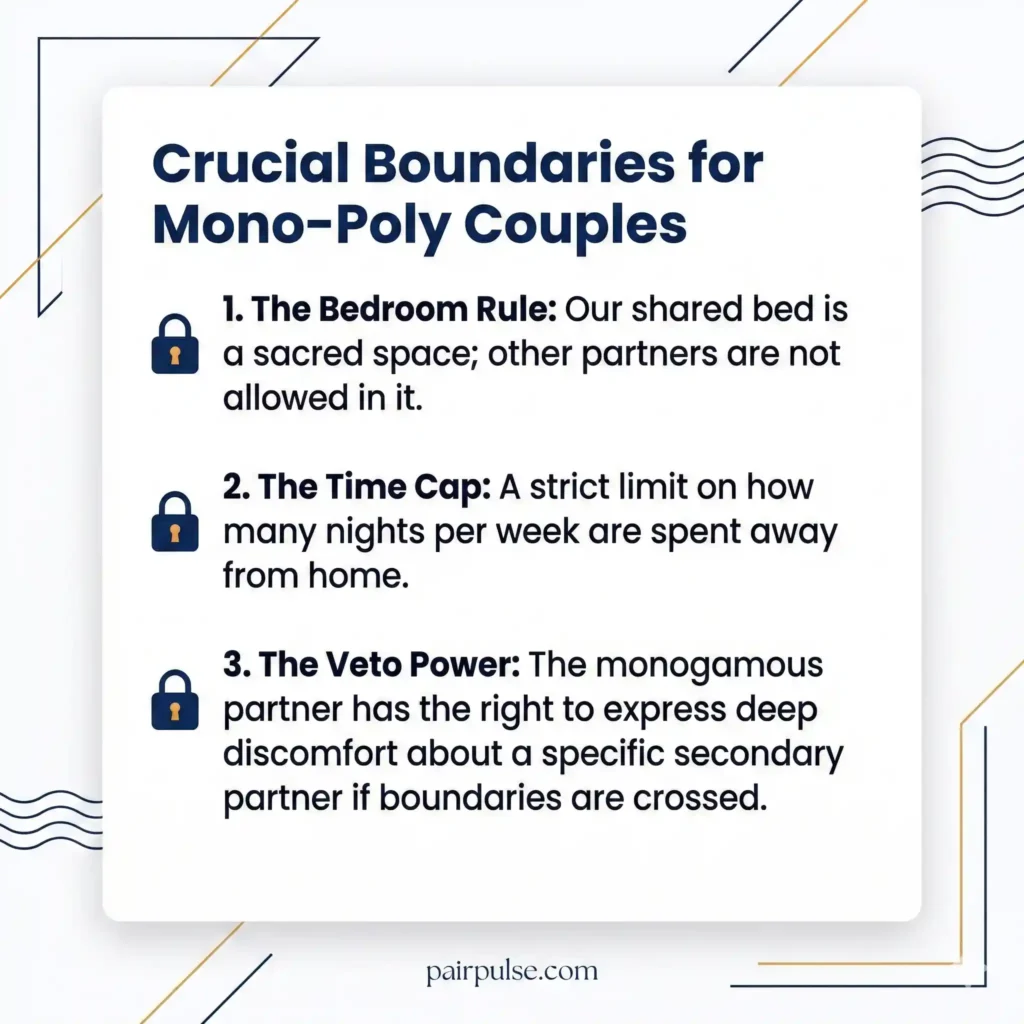
If you find yourself in a mono-poly dynamic and you genuinely want to try and make it work, you must establish titanium-clad boundaries. You cannot just “go with the flow.”
1. Establish the “Pace Car” Rule
In a healthy mono-poly relationship, the monogamous partner must act as the “pace car.” This means the relationship only opens up as fast as the monogamous partner is comfortable with. If the monogamous partner needs the polyamorous partner to slow down, pause dating, or take a month off to focus on the primary relationship, the polyamorous partner must agree without resentment.
2. Radical Reassurance
The polyamorous partner must put in 10x the effort to validate the monogamous partner. Research from the Kinsey Institute emphasizes that individuals with anxious attachment styles require overt, consistent communication to feel secure. The polyamorous partner must actively date their primary partner, plan romantic evenings, and offer constant reassurance that their primary bond is safe.
3. Compartmentalization
The monogamous partner needs strict boundaries regarding what they want to know. Some monogamous partners want to meet their partner’s other lovers (a “kitchen table” dynamic). Others want a strict “Don’t Ask, Don’t Tell” (DADT) policy, where they know the partner is dating, but they never want to hear a name or see a text message. Define this boundary immediately.
Knowing When to Walk Away
Love is not enough to sustain a relationship if your core values are fundamentally at war.
If you are the monogamous partner, you must ask yourself a brutal question: Am I enduring this because I am growing, or am I enduring this because I am terrified of being alone? If you are losing weight from stress, crying multiple times a week, or constantly checking their phone location, the relationship has become toxic to your biology. Taking an objective, expert-backed Should I Break Up Quiz can often cut through the emotional fog and help you realize that your nervous system is begging you to leave.
You cannot force a monogamous heart to be polyamorous, just as you cannot force a polyamorous heart to be strictly monogamous. Sometimes, the most profound act of love you can offer each other is the willingness to let go, allowing both of you to find relationship structures that actually bring you peace.
Frequently Asked Questions (FAQs)
1. Is it fair for my partner to ask for a one-sided open relationship?
It is fair for them to express their true desires and orientation. However, it is not fair for them to pressure, guilt, or manipulate you into accepting it. You have every right to say, “I love you, but I require complete monogamy to feel safe in a relationship.”
2. Will they eventually realize they only need me?
This is the most dangerous hope a monogamous partner can hold onto. If someone is truly polyamorous, it is their orientation, not a phase. They will not “get it out of their system.” If you stay, you must accept that they will likely want multiple partners for the rest of their lives.
3. How do I stop being jealous when they are on a date?
If you are fundamentally monogamous, you might never stop feeling jealous. However, you can manage the anxiety by distracting yourself. Plan your own “dates” with yourself or your friends on the nights they are out. Take a class, go to a movie, and refuse to sit at home staring at the clock.
Final Thoughts: Choosing Your Peace
One-sided polyamory is the ultimate test of relationship compatibility. It asks two people speaking entirely different languages to somehow write a story together.
While it can work in very rare, highly communicative scenarios, it requires a level of emotional maturity and self-sacrifice that most human beings simply do not possess. Do not force yourself to endure a relationship structure that crushes your spirit just to keep a partner. Your mental health, your peace, and your boundaries are far more valuable than a relationship that requires you to compromise your core identity.
Are you currently navigating a mono-poly relationship? What boundaries have you set to protect your peace? Share your story with the PairPulse community in the comments below!