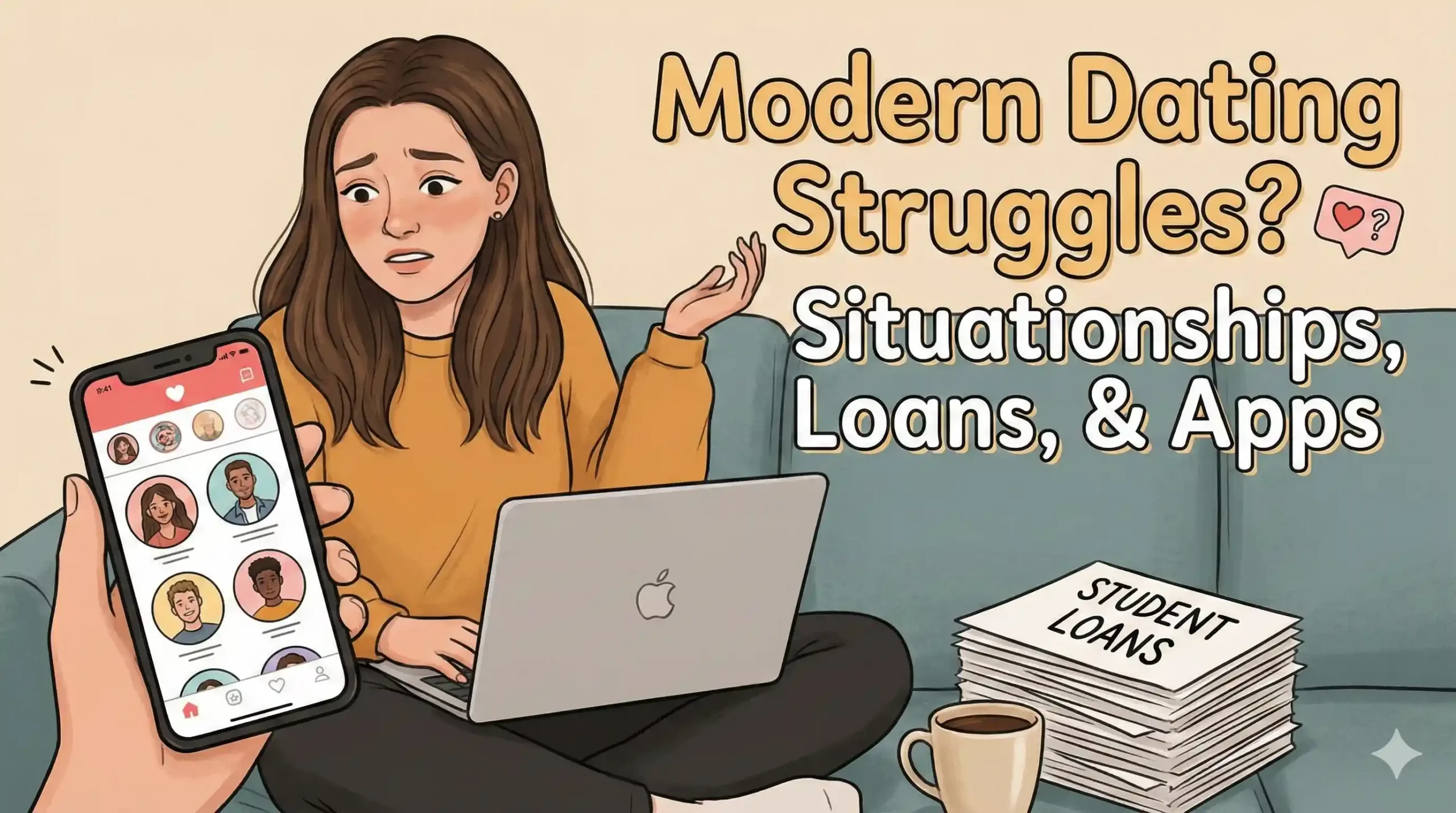
Your 20s in America are sold to you as the “best years of your life.”
Movies tell you it will be a montage of rooftop parties in Brooklyn, romantic road trips to Big Sur, and falling in love with a charming stranger in a coffee shop.
The Reality:
It’s mostly swiping left on Hinge until your thumb hurts, decoding cryptic texts from someone who “doesn’t like labels,” and trying to afford a dinner date while drowning in student loan debt.
According to a Pew Research Center study, nearly half of U.S. adults under 30 are single. We are the loneliest, most anxious, and most digitally connected generation in history.
But here is the good news: Your 20s are not for finding the perfect person; they are for finding yourself so you can recognize the right person when they show up.
At PairPulse, we know the struggle is real. In this guide, we are cutting through the noise. We will tackle the “Situationship” epidemic, navigating love when you are broke, and how to build a real connection in a disposable world.

1. The “Situationship” Epidemic: How to escape
Welcome to modern dating in the USA, where nobody wants to admit they care.
A “Situationship” is that gray area between “hanging out” and “being a couple.” You sleep over, you buy groceries together, but you are technically single.
Why it happens:
Fear of missing out (FOMO) and the illusion of infinite choice on dating apps make people terrified of commitment.
The “Exit Strategy” Checklist:
If you are stuck in a situationship and want more, use this checklist to decide your next move.
- [ ] The 3-Month Rule: Have you been seeing each other for 3 months without a title? It’s time to speak up.
- [ ] The “Soft” Ask: Don’t say “We need to talk.” Say: “I’m really enjoying getting to know you, and I’m at a point where I’m not interested in seeing other people. Where is your head at?”
- [ ] The Walk-Away Power: If they say “I’m not ready for a relationship right now,” believe them. Do not stick around hoping to change their mind. Leave.
2. Dating on a Budget: Love vs. Inflation
In 2026, the average cost of a “Dinner and a Movie” date in major US cities (NYC, LA, Chicago) can easily top $150. When you are paying off student loans and dealing with sky-high rent, dating feels like a luxury tax.
Financial Etiquette in Your 20s:
| Scenario | Old School Rule | The 2026 Reality |
| First Date Bill | The man pays 100%. | Split it (Go Dutch) or the inviter pays. Splitting is financially responsible and removes pressure. |
| Date Location | Fancy Dinner. | Coffee or Walk. Low investment ($5-10) until you know you actually like them. |
| Talk about Debt | Taboo/Never discuss. | Essential. Discussing student loans/credit scores early prevents resentment later. |
The “High-Value, Low-Cost” Date Ideas:
- Museum Days: Many US museums have “Free Admission” days or student discounts.
- Trader Joe’s Picnic: Grab a $5 wine and some cheese, go to a park.
- Volunteering: Do good together. It’s free and shows character.
3. The “Paradox of Choice”: Why Apps Are Making Us Lonely
American young adults spend an average of 10 hours a week on dating apps. Yet, satisfaction is at an all-time low.
This is the Paradox of Choice: The more options you have, the less satisfied you are with the one you pick.
How to Beat the Algorithm:
- Limit Your Swiping: Treat it like a job. 15 minutes a day, then close the app.
- Date Intentionality: Stop matching with people just for an ego boost. Only swipe right if you would actually meet them for coffee tomorrow.
- The “Slow Dating” Movement: Talk to one person at a time. It sounds radical, but focusing your energy yields better results than juggling 5 conversations that go nowhere.
Gut Check: Are you chasing a “fantasy” checklist (6ft tall, rich, funny) or looking for genuine compatibility? Use our Couple Compatibility Score to see if your values align with the people you are matching with.

4. Career vs. Love: The 20-Something Dilemma
In the US, your 20s are the “Hustle Years.” You are expected to build a career, side hustle, and network.
- The Conflict: You get a job offer in San Francisco. Your partner is in grad school in Boston. Who moves?
The “Traffic Light” Theory:
- Red Light: You have been dating for 3 months. Do not sacrifice your career for them.
- Yellow Light: You have been together 1-2 years. Can you do long distance for a set time (e.g., 1 year)?
- Green Light: You are partners for life. You make the decision as a “We,” prioritizing the collective future over individual ego.
Remember: A career will never wake up one morning and tell you it doesn’t love you anymore. But a career also won’t hold your hand in the hospital. Balance is key.
5. Green Flags: What to Actually Look For
We talk a lot about Red Flags (Narcissism, Ghosting). But in your 20s, you need to learn to spot Green Flags. These are the signs of emotional maturity.
The “Keeper” Checklist:
- [ ] Emotional Regulation: They don’t scream or punch walls when angry. They can say “I’m frustrated” calmly.
- [ ] Consistency: Their actions match their words. If they say they will call at 5 PM, they call at 5 PM.
- [ ] Growth Mindset: They are working on themselves (therapy, reading, fitness). They don’t blame the world for their problems.
- [ ] They Celebrate You: They are genuinely happy when you succeed, not jealous or competitive.
6. Cohabitation: Moving In Before Marriage
Living together is the new norm in the US. According to the National Center for Health Statistics, over 70% of couples live together before marriage.
The “Sliding vs. Deciding” Effect:
- Sliding: You move in because your lease is up and it saves rent money. (Higher risk of breakup).
- Deciding: You move in because you want to deepen the relationship and have discussed the future. (Lower risk).
Before you sign a lease:
Have the uncomfortable talk. “What happens if we break up? Who keeps the apartment? Who keeps the dog?” Put it in writing. It’s not unromantic; it’s smart.

7. Frequently Asked Questions (FAQs)
Is 25 too young to get married in the US?
The average age of marriage in the US is now ~30 for men and ~28 for women. While 25 isn’t “too young” biologically, statistically, waiting until 25+ drastically reduces divorce risk because your brain (prefrontal cortex) is fully developed.
How do I handle “Ghosting”?
Reframe it. Ghosting is not a reflection of your worth; it is a reflection of their inability to communicate. Do not chase a ghost. Block the number and move on.
My parents hate my partner. What do I do?
In your 20s, you are establishing independence. Listen to their concerns (are they seeing abuse you are missing?), but ultimately, you are the one who has to live with the person, not them. Set boundaries if they are being disrespectful.
Is it okay to be single in my late 20s?
Absolutely. Being single allows you to travel, invest in your career, and learn who you are without compromise. It is infinitely better to be single at 29 than divorced at 30.
Conclusion: Write Your Own Rules
The “American Dream” of marriage, house, and kids by 25 is outdated.
Your 20s are a messy, beautiful experiment. You will get your heart broken. You will date people who are wrong for you. You will make mistakes.
But every heartbreak is a data point. Every bad date teaches you what you don’t want, bringing you one step closer to what you do want.
So, take a deep breath. Stop comparing your life to your friend’s Instagram highlight reel. You are exactly where you need to be.