If you have ever been to a therapist, read a relationship book, or even just scrolled through TikTok for five minutes, you have probably heard of the “5 Love Languages.”
Coined by Dr. Gary Chapman in 1992, the framework is beautifully simple: human beings give and receive love in five distinct ways—Words of Affirmation, Acts of Service, Receiving Gifts, Quality Time, and Physical Touch. For decades, this framework has been the absolute gold standard for couples trying to decode why they feel disconnected. “Oh, he bought me a necklace (Gifts), but all I actually wanted was for him to empty the dishwasher (Acts of Service).”
But if you are reading this on PairPulse today, you might have noticed something shifting in your own relationship. In the modern, hyper-connected, deeply exhausting world we live in, the original five languages sometimes feel like they aren’t quite enough to bridge the communication gap.
The way we live has completely evolved. We work from home side-by-side, we are constantly bombarded by digital notifications, and we are managing unprecedented levels of anxiety. Because our environments have changed, the way we crave love is fundamentally changing, too. Today, we are exploring the fascinating evolution of modern love languages, and how understanding these new dynamics can completely transform the way you and your partner communicate.
The Evolution: Why the Original 5 Aren’t Enough Anymore
To be clear, Dr. Chapman’s original five love languages are still incredibly valid. They are the psychological foundation of romantic connection. However, modern couples are realizing that the application of these languages must adapt to the 21st century.
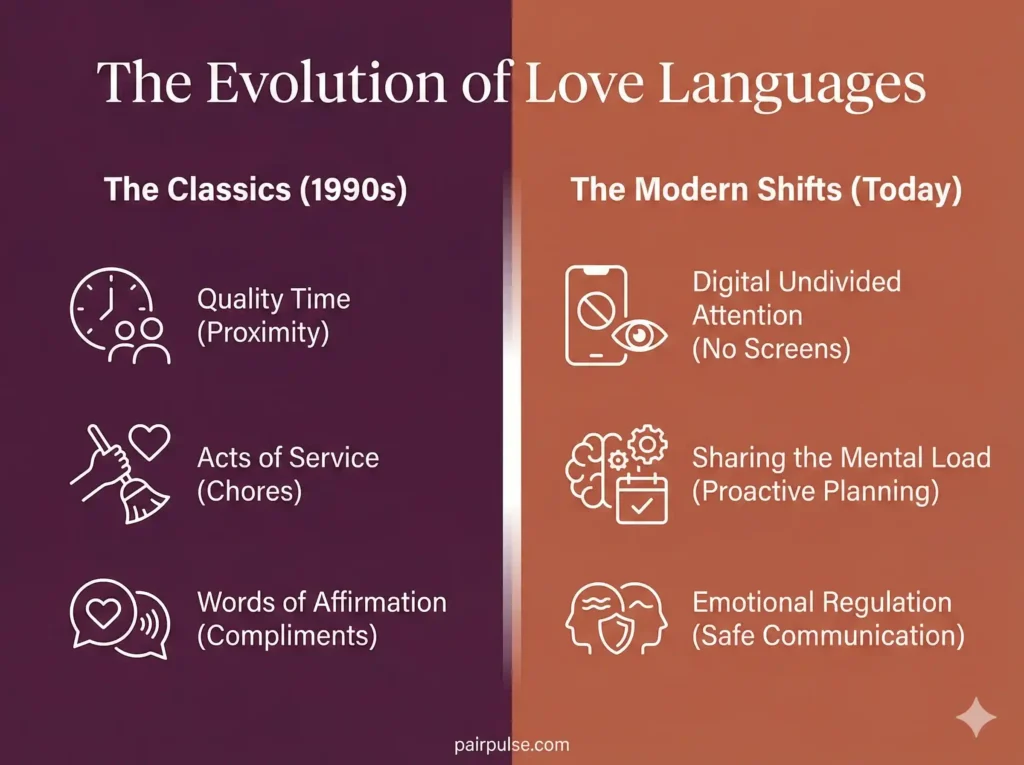
Consider “Quality Time.” In 1992, Quality Time meant sitting in the same room after work. Today, you and your partner might both work remotely from the exact same living room for 40 hours a week. You have an abundance of physical proximity, but you still feel incredibly lonely. Why? Because proximity does not equal presence.
This realization is forcing couples to look deeper into how to improve emotional intimacy. It isn’t just about spending time together anymore; it is about the quality of attention during that time. This shift has given rise to what many relationship psychologists are unofficially calling the “Modern Love Languages.”
The 3 “New” Modern Love Languages
If you feel like you and your partner are missing each other’s signals despite trying the classic five languages, you might actually be speaking one of these emerging modern dialects.
1. Shared Mental Load (The Ultimate Act of Service)
In the past, an Act of Service might have been cooking dinner or taking out the trash. Today, the most deeply craved love language for many partners (especially women) is the sharing of the “Mental Load.”
The mental load is the invisible, exhausting project management of running a life: remembering that the dog needs a vet appointment, knowing we are out of paper towels, and planning the logistics of the upcoming holiday.
- How it looks in practice: “I noticed we were getting low on coffee, so I ordered your favorite roast yesterday. Also, I already RSVP’d to your sister’s dinner party.”When a partner proactively takes on the mental load without needing to be “managed” or told what to do, it creates a massive surge of relief and romantic attraction.
2. Digital Undivided Attention (The New Quality Time)
We are the most distracted generation in human history. When your phone buzzes with a work email, a breaking news alert, and a text from your mother all at once, your attention is fractured.
Today, giving someone your “Digital Undivided Attention” is the highest form of romantic luxury.
- How it looks in practice: Putting your phone physically in another room, or turning it completely face-down on the table during dinner. It is the active, deliberate choice to say, “Out of everything screaming for my attention right now, I am choosing to focus entirely on you.”
3. Emotional Regulation (The New Words of Affirmation)
Modern life is highly stressful. When we are stressed, we often project that anxiety onto our partners through snapping, short tempers, or passive-aggressive comments.
The modern love language of “Emotional Regulation” means doing your own internal psychological work so you don’t bleed your stress all over your partner. It means communicating your boundaries calmly. If your partner has an avoidant attachment style, you might have already realized this. Understanding how do you know if your avoidant partner loves you often reveals that their attempt to self-soothe and regulate their own emotions before coming back to a conversation is actually a profound act of love.
What Happens When Your Languages Clash?
Even with the addition of these modern nuances, the biggest hurdle couples face is a “bilingual” mismatch. You are speaking French, and they are speaking Mandarin. You are both trying to communicate love, but neither of you is understanding the other.
For example, if your love language is Shared Mental Load, but your partner’s is Physical Touch, you will end up in a cycle of profound frustration. You will be angry that they didn’t help plan the weekend, and they will be heartbroken that you rejected their hug because you were too stressed about planning the weekend.
How to Bridge the Communication Gap:
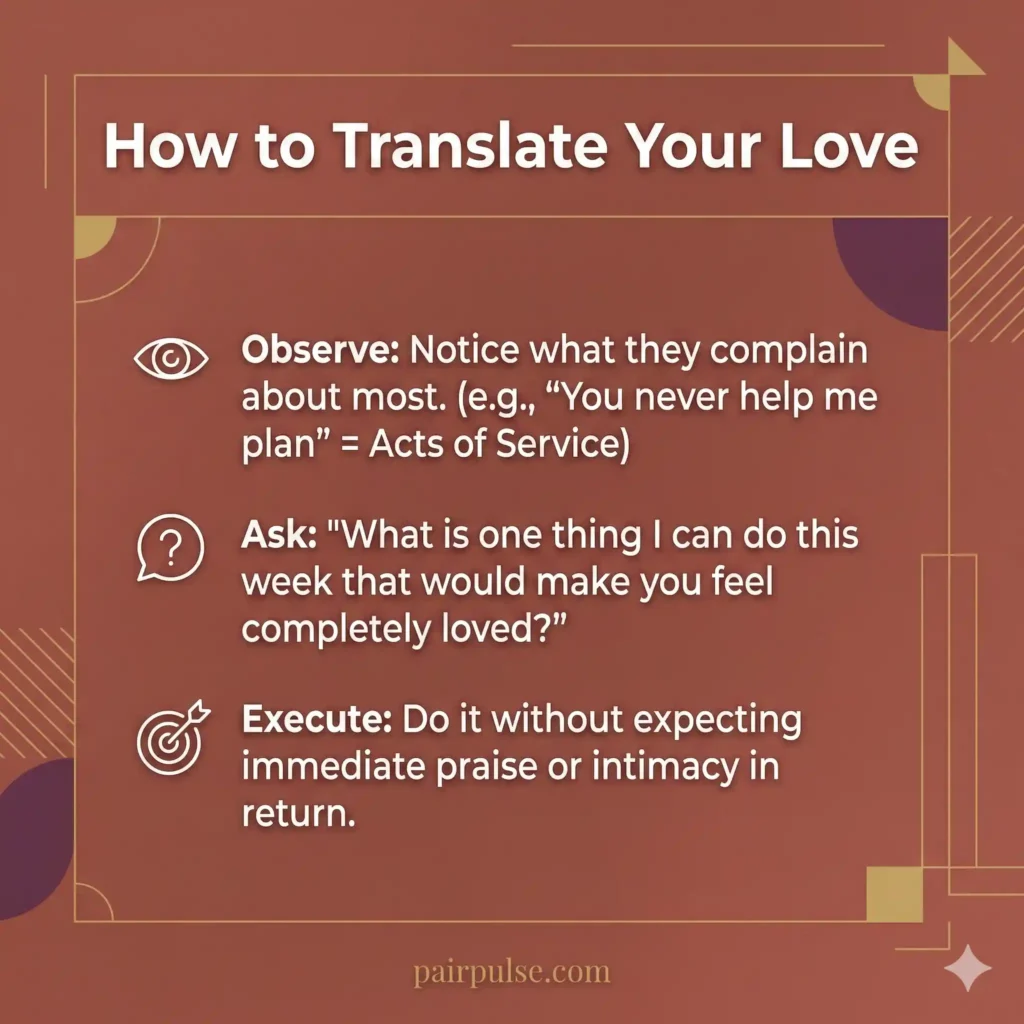
- Stop Loving Them How YOU Want to Be Loved: This is the golden rule. We default to giving the love we want to receive. If you love gifts, you buy them gifts. But if they don’t care about gifts, your effort is wasted. You have to actively learn to speak their specific dialect.
- Remove the Mind-Reading Expectation: Your partner cannot read your mind. If you need them to put their phone away for an hour, you have to clearly and kindly ask for it.
- Assess Your Baseline Compatibility: Sometimes, a massive clash in love languages is a symptom of a deeper lifestyle disconnect. Taking a low-pressure, objective couple compatibility score quiz together can be an incredibly eye-opening exercise. It helps you see where your natural alignments are, and where you need to put in deliberate, conscious effort to translate your love for one another.
Using Love Languages to Heal Trauma
Love languages are not just for the good times; they are the ultimate tool for crisis management.
When a relationship goes through a massive trauma—such as infidelity, a major financial betrayal, or a period of intense emotional neglect—the default communication completely breaks down. If you are doing the grueling work of rebuilding trust after a lie, you cannot rely on standard apologies.
You must apologize in your partner’s love language.
- If their language is Words of Affirmation, they need to hear a detailed, verbal acknowledgment of your remorse and exactly how you plan to fix it.
- If their language is Acts of Service / Mental Load, they need to see you proactively booking the couples therapy sessions without them having to ask.
- If their language is Quality Time / Digital Attention, they need you to sit with them in their pain, completely undistracted, answering their questions patiently.
Healing requires you to become perfectly fluent in the exact language your partner needs to feel safe again.
Frequently Asked Questions (FAQs)
Can your love language change over time?
Absolutely. Love languages are highly fluid and shift based on the season of life you are in. When you are long-distance, Words of Affirmation might be your primary language. When you have a newborn baby, Acts of Service (and sleep!) will almost certainly become your primary desire. You must constantly “re-learn” your partner as your life evolves.
Is it bad if my partner and I have completely different love languages?
Not at all. In fact, most couples have completely different love languages. It only becomes a problem if one or both partners are entirely unwilling to learn the other person’s language. A successful relationship is built on the willingness to step outside your comfort zone to make the other person feel valued.
How do I figure out what my own modern love language is?
Look at your resentments. We usually discover our love language by identifying what hurts us the most when it is missing. If you feel deeply neglected when your partner scrolls on their phone while you are talking, your language is Digital Undivided Attention. If you feel furious when you have to plan every date, your language is Shared Mental Load.
Final Thoughts: The Choice to Communicate
The evolution of love languages is a beautiful reminder that a long-term relationship is not a static destination. It is a living, breathing entity that requires constant adaptation.
Understanding how couples communicate today means accepting that love is a daily choice. It is the choice to put the phone down. It is the choice to take on the mental load. It is the choice to look at the person sitting across from you and say, “I see how the world is changing, and I am willing to learn new ways to love you.”
Stop expecting your partner to read your mind, and start actively translating your affection. When you finally learn to speak each other’s language fluently, you won’t just communicate better—you will experience a depth of connection you never knew was possible.
What is your primary “Modern” love language? Have you and your partner struggled to translate your needs to each other? Share your communication breakthroughs with the PairPulse community in the comments below!