
I will never forget the first Friday night after I moved to a new city for my first “real” post-college job. I sat on my second-hand couch, ordered a pizza for one, and aimlessly scrolled through my phone. I watched my college friends, now scattered across the country, posting stories of their new lives.
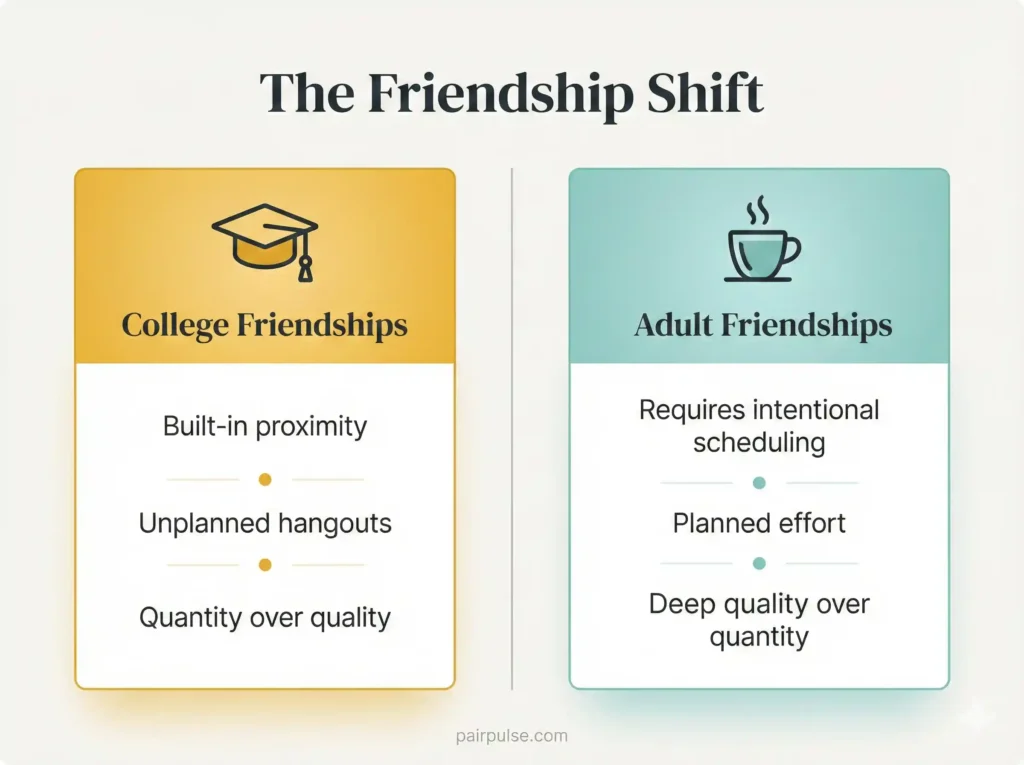
And then, a terrifying realization hit me like a ton of bricks: I do not know a single person in a 50-mile radius, and I have absolutely no idea how to make a friend as an adult. If you are reading this on PairPulse today, I can almost guarantee you have felt that exact same sinking feeling in your chest. In college, making friends was effortless. You were constantly surrounded by thousands of people exactly your age, going through the exact same life stage, in the exact same geographic location. You made friends just by sitting next to someone in a lecture hall or sharing a plate of fries in the dining hall. It was built-in, frictionless community.
But then you graduate. The structured bubble pops. Suddenly, you are dropped into the adult world where everyone is busy, tired after work, and already seems to have their established, closed-off friend groups. The loneliness can feel incredibly overwhelming, isolating, and honestly, slightly embarrassing to admit.
But I want you to take a deep breath. You are not weird, you are not unlikable, and you are definitely not the only one feeling this way. Today, we are going to talk openly about the reality of adult loneliness, and I am going to give you a highly practical, step-by-step roadmap on how to make friends in your 20s after college.
The Science of Adult Loneliness: Why Is It So Hard Now?
Before we talk about how to fix it, we need to validate your struggle. The difficulty of making friends in adulthood is not in your head; it is a proven sociological phenomenon.
Back in the 1950s, sociologists discovered that the number one predictor of friendship is proximity. Proximity means repeated, unplanned interactions. In college, you had constant proximity to your peers. In the adult world, unless you count your coworkers (who are often in different life stages or just want to go home), you have zero built-in proximity.
Furthermore, we are living in the middle of a documented loneliness epidemic. Young adults in their 20s actually report higher levels of loneliness than the elderly. Why? Because society forgot about the “Third Place.” Coined by sociologist Ray Oldenburg, a “Third Place” is a social surrounding separate from the two usual social environments of home (“First Place”) and the workplace (“Second Place”).
Coffee shops, local parks, community centers, and libraries used to be bustling Third Places. Today, thanks to remote work, endless streaming services, and the digital age, our Third Places have practically vanished. To make friends in your 20s, you have to actively and intentionally engineer your own proximity.
5 Actionable Strategies to Build Your Community
Making friends as an adult requires a massive mindset shift. You can no longer be passive; you have to treat friendship with the same intentionality as your career or your dating life.
1. Treat Friendship Like Dating (The “Friend Date”)
When you are looking for romance, you understand that you have to put yourself out there, risk rejection, and initiate plans. Making friends in your 20s requires the exact same energy. In fact, finding a new best friend often requires the same level of effort as decoding casual dating. You have to read the room, make the first move, and follow up.
- The Action Step: If you meet someone cool at a work event or a local coffee shop, be brave. Say something simple like, “Hey, I’m actually new to the area and trying to meet some cool people. Would you be down to grab a coffee or check out that new bakery sometime this weekend?” Yes, it feels awkward. Yes, you might get a polite “no.” But the ultimate reward of a deep connection is absolutely worth the temporary discomfort.
2. Leverage the Power of the “Routine”
Remember the concept of proximity we talked about? You have to engineer it in your own life. You will rarely make a deep friendship by going to a crowded bar one time. You make friends by showing up to the same place, at the same time, every single week.
- The Action Step: Become a “regular.” Go to the same Saturday morning workout class and stand in the exact same spot. Bring your laptop to the same neighborhood coffee shop every Tuesday evening. When you become a familiar face, the psychological barrier to saying “hello” drops significantly. Familiarity breeds comfort, and comfort breeds friendship.
3. Lean Hard Into Your Niche Hobbies
The beautiful thing about your 20s is that you no longer have to pretend to like things just to fit in with your dorm mates. You can find people who share your weird, specific passions. When you connect over a shared interest, the awkward small talk is completely bypassed.
- The Action Step: Join a local running club, a pottery class, a board game café night, or a recreational kickball league. Use platforms like Meetup to find hyper-specific groups in your city. Shared activities remove the pressure of maintaining a conversation because the activity itself is the focal point.
4. Upgrade Your “Weak Ties”
Sometimes, your best future friends are people you already know, just not very well. Sociologists call these “weak ties.” Maybe it’s an acquaintance from your high school who happened to move to the same city as you, or a friend-of-a-friend you met at a birthday party two years ago.
- The Action Step: Slide into their DMs. You don’t need a grand excuse. If they post a great photo, you don’t have to overthink it like you are trying to craft the perfect Instagram captions for couples —just reply to their story! Send a message saying, “Hey! I saw you moved to Denver too. I’ve been here for a few months and I’m trying to explore the city more. We should grab a drink sometime and catch up!” Because there is already a baseline of familiarity, these reach-outs have an incredibly high success rate.
5. Utilize Technology (It’s Not Just for Romance)
If we use apps to find romantic partners, why shouldn’t we use them to find platonic ones? Bumble BFF is a massively popular tool for people in their 20s navigating new cities.
- The Action Step: Create a profile that clearly states your interests and what you are looking for. Don’t just match and wait; send the first message and try to transition to a low-stakes, real-life meetup (like grabbing a quick matcha) within the first week of chatting.
Deepening the Connection: Moving from Acquaintance to Friend
Meeting people is only phase one. Phase two is turning an acquaintance into a genuine, ride-or-die friend.
This requires immense emotional vulnerability. Just as you would work hard to how to improve emotional intimacy in a romantic relationship, you have to peel back the layers in a friendship. Instead of just talking about the weather or complaining about your boss, you have to start sharing your real fears, your big dreams, and your messy failures.
Furthermore, if you have ever been hurt by a toxic friend in the past, opening up can be terrifying. Learning to let someone new into your life requires the same patience as trying to rebuild trust after a lie. Protect your peace, look for green flags like consistency and active listening, but do not let past pain close you off from future joy.
In adulthood, if you do not actively schedule time with someone, you will simply never see them. Take on the role of the “planner.” Be the person who organizes the Sunday brunch or hosts the terrible movie night at your apartment.

Frequently Asked Questions (FAQs)
Is it normal to have no friends in your 20s?
It is incredibly common and absolutely nothing to be ashamed of. The transition out of college is arguably the most jarring social shift of your entire life. Millions of people in their 20s are starting completely from scratch in new cities, remote jobs, and shifting identities. You are simply in a transitional season of your life.
How do I make friends if I work remotely and never leave my house?
Remote work makes this harder, but not impossible. You have to force yourself to leave the house. Consider working from a co-working space one or two days a week to build proximity with other remote workers. Alternatively, join clubs or groups that meet strictly in the evenings or on weekends so your social life isn’t tied to an office building.
What do I do if my college friends are drifting away?
Mourn the shift, but accept it as a deeply natural part of growing up. Not every friendship is meant to be a lifelong, daily presence. Some friends are for a “season,” and that is beautiful. Keep in touch, celebrate their major life milestones, but redirect the majority of your daily emotional energy toward building a local community where you currently live.
Final Thoughts: The Courage to Say Hello
Making friends in your 20s after college is scary. It requires you to step outside of your comfort zone, embrace a little bit of awkwardness, and be fiercely vulnerable.
But I promise you this: there is someone out there in your city, sitting on their own couch on a Friday night, scrolling through their phone, wishing they had a friend exactly like you. You just have to be brave enough to go find them.
Stop waiting for community to magically happen to you. Go out there and build it.
Have you struggled with making friends after college? What is one strategy or hobby that actually worked for you? Drop your advice in the comments below—your tip might be exactly what someone else in the PairPulse community needs to read today!
2 thoughts on “How to Make Friends in Your 20s After College: A Survival Guide”