
I will never forget the evening I realized something was terribly wrong in my relationship. We were sitting on the same couch, watching the exact same Netflix show, eating the same takeout food. Physically, we were just inches apart. But emotionally? We felt like we were sitting on entirely different planets.
Have you ever felt that? That chilling sensation of looking at the person you love most in the world and realizing you feel more like polite roommates than passionate life partners.
If you are reading this on PairPulse, I know exactly why you clicked. You are tired of the surface-level conversations. You are exhausted by the routine of “How was work?” followed by “Good, yours?” You are craving that deep, soul-baring connection you had in the beginning—the kind where a single glance across the room told you everything you needed to know.
The good news? You are not broken, and neither is your relationship. The gradual fading of emotional closeness is incredibly common, but it is also completely reversible. Today, I want to sit down with you and share exactly how to improve emotional intimacy, tear down those invisible walls, and build a stronger, more bulletproof connection with your partner.
What Actually Is Emotional Intimacy? (And Why It Matters More Than You Think)
Before we start fixing things, we need to understand what we are actually trying to build. Many people confuse emotional intimacy with physical intimacy. While physical intimacy is about sharing your body, emotional intimacy is about sharing your absolute, unfiltered truth.
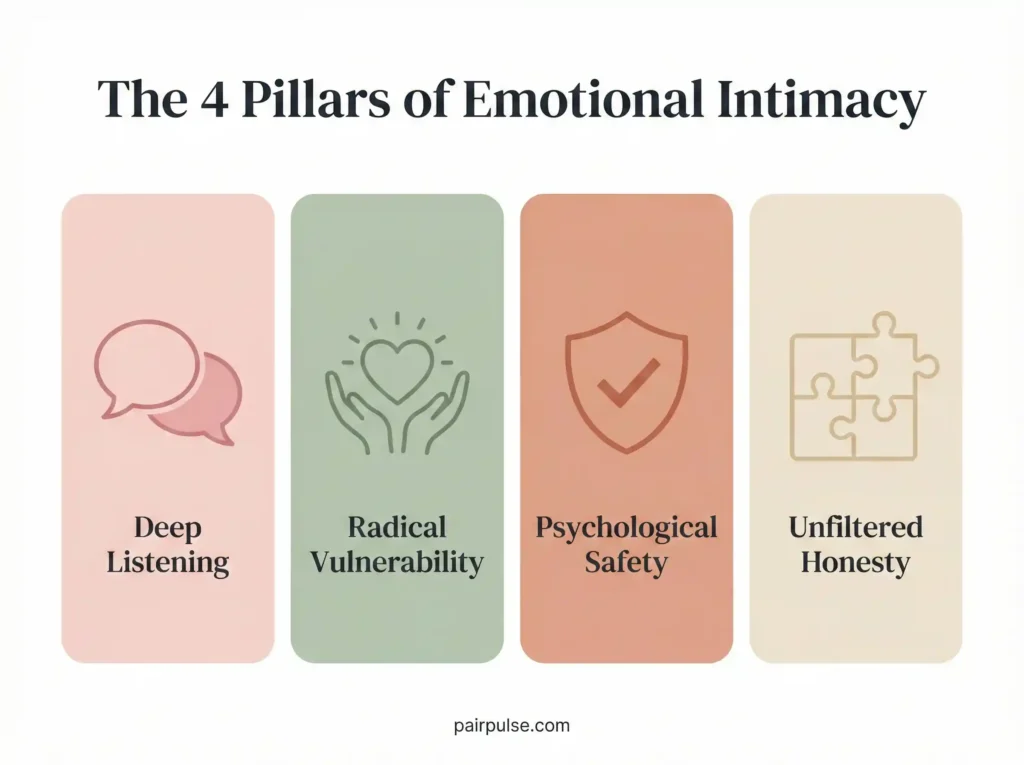
Emotional intimacy is the profound sense of psychological safety you feel with another person. It is the quiet confidence of knowing that you can share your darkest fears, your wildest dreams, and your most embarrassing failures without the fear of being judged, mocked, or rejected.
According to research published by the American Psychological Association, emotional intimacy is the primary predictor of long-term relationship satisfaction. Without it, physical intimacy eventually feels hollow, arguments become increasingly destructive, and loneliness starts to creep into the relationship.
If you want your love to last a lifetime, you cannot just rely on romance. You have to cultivate an environment where both of you feel incredibly safe being entirely yourselves.
The 4 Silent Killers of Emotional Intimacy
If we want to build a stronger connection, we first have to stop doing the things that are secretly destroying it. Emotional distance rarely happens overnight. It is the result of hundreds of tiny paper cuts. Here are the four silent killers you need to watch out for:
1. The “Fix-It” Reflex
When your partner comes to you venting about a horrible day at work, what is your first instinct? If you immediately start offering solutions, playing devil’s advocate, or telling them how they should have handled it, you are unintentionally shutting down their emotional vulnerability. Sometimes, they don’t want a consultant; they just want a safe harbor.
2. Chronic “Phubbing” (Phone Snubbing)
We live in an era of constant distraction. If you are scrolling through Instagram or checking work emails while your partner is trying to tell you about their day, you are sending a devastating subconscious message: “My screen is more important than your heart.”
3. Sweeping Resentments Under the Rug
Many couples think they have a “great relationship” simply because they never fight. But avoiding conflict does not create peace; it creates a cold war. Unspoken resentments build an invisible brick wall between you over time. You cannot be emotionally intimate with someone you are secretly holding a grudge against.
4. The Deep Fear of Vulnerability
Let’s be honest—opening up is terrifying. Society often teaches us to wear armor, to look strong, and to never show weakness. But in a relationship, your armor is your biggest enemy. If you never take off your emotional armor, your partner can never truly hold you.
How to Rebuild Emotional Intimacy: 5 Actionable Steps
Now that we know what to avoid, let’s get to work. Improving emotional intimacy is like going to the gym for your heart. It requires consistent, daily reps. Here is my step-by-step roadmap to deeply connecting with your partner again.
Step 1: Create a “No-Screen Sanctuary”
You cannot connect with your partner’s soul if you are both staring at a glowing rectangle.
- The Action Plan: Designate at least 30 minutes every single evening as completely screen-free time. Put the phones in another room. Turn off the TV. Sit on the couch together, pour a glass of wine or a cup of tea, and simply look at each other. The first few days might feel awkwardly quiet, but eventually, the silence will give birth to beautiful, spontaneous conversations.
Step 2: Practice “The 10-Minute Rule”
When we get busy, our conversations devolve into logistics. “Did you pay the electric bill? Can you pick up the kids? We are out of milk.” This is the fast track to Roommate Syndrome.
- The Action Plan: I highly recommend implementing a daily practice designed by The Gottman Institute, known as the stress-reducing conversation. Spend exactly 10 minutes every day talking about anything other than the kids, the house, the bills, or your relationship issues. Talk about your hopes, a funny childhood memory, or a wild dream you had. Re-discover the person behind the “partner” label.
Step 3: Shift from “How was your day?” to “How are you feeling?”
“How was your day?” is a dead-end question. It almost always results in a one-word answer: “Fine.” If you want to dive deeper, you have to ask better questions.
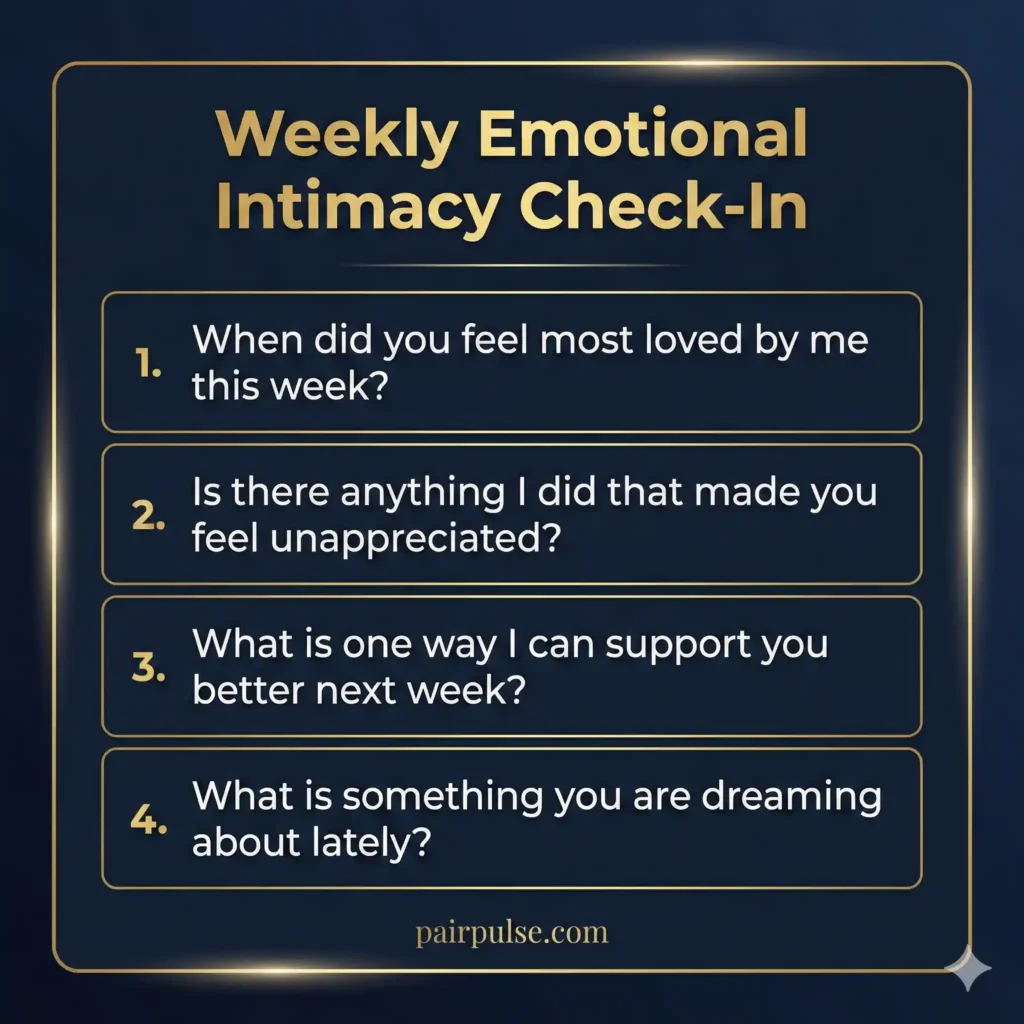
- The Action Plan: Start asking open-ended, emotion-focused questions. Try asking: “What was the hardest part of your day today?” or “What is something that made you smile this week?” or “Is there anything weighing heavily on your mind right now that I can help carry?” These questions invite vulnerability rather than a status update.
Step 4: Validate Before You Advise
Remember the “Fix-It” reflex we talked about earlier? It is time to turn it off. When your partner shares a struggle with you, your only job is to make them feel heard, seen, and validated.
- The Action Plan: Before you offer a single piece of advice, look them in the eyes and say, “That sounds incredibly frustrating, and I completely understand why you feel that way. I am so sorry you are dealing with this.” Validation builds an immediate bridge of empathy. Once they feel deeply understood, then you can ask, “Do you want my advice, or do you just need me to listen right now?”
Step 5: Take the Risk of Going First
If you are waiting for your partner to magically become vulnerable, you might be waiting forever. Someone has to be brave enough to take the first step onto the ice. Let it be you.
- The Action Plan: Tonight, share a fear or an insecurity with your partner that you have never spoken out loud. Say something like, “I’ve been feeling really insecure about my career lately,” or “Sometimes I worry that I’m not doing a good enough job as a partner.” When you drop your shield, it gives them the subconscious permission to drop theirs too.
The PairPulse Challenge: 7 Days to a Deeper Bond
I don’t just want you to read this article and move on with your day. I want to challenge you to take immediate action. Here at PairPulse, we believe in doing the work.
For the next 7 days, commit to offering your partner at least one completely unprompted, highly specific compliment every single day. Do not just say “You look nice.” Say, “I absolutely love how passionate you get when you talk about your hobbies,” or “I deeply appreciate how hard you work for our family; it never goes unnoticed.” Watch how quickly their emotional walls start to melt.
Frequently Asked Questions (FAQs) About Emotional Intimacy
How do I tell my partner I need more emotional intimacy without sounding needy or critical?
Approach the conversation using “I” statements rather than “You” statements. Instead of saying, “You never talk to me anymore,” try saying, “I have been missing you so much lately. I miss our deep conversations, and I would love to spend some distraction-free time together this weekend.” This removes the blame and invites them into a solution.
Can rebuilding emotional intimacy restore a sexless or struggling marriage?
Absolutely. For the vast majority of people (especially women), physical arousal is directly tied to emotional connection. When you feel unheard, unappreciated, or emotionally abandoned, your body naturally shuts down physical intimacy as a protective mechanism. By repairing the emotional bridge first, the physical passion almost always naturally follows.
What if my partner is completely emotionally unavailable and refuses to open up?
You cannot force someone to be vulnerable. If your partner has deep-seated trauma or an avoidant attachment style, pushing them too hard will only make them retreat further. Model vulnerability yourself, create a highly safe, non-judgmental environment, and consistently show up. If years go by without progress, seeking a licensed couples therapist is highly recommended to help break through those defensive walls.
Final Thoughts: The Courage to Connect
Improving emotional intimacy is not about grand, romantic gestures. It isn’t about expensive vacations or diamond rings. It is about the quiet courage it takes to look at your partner, strip away all your ego, and say, “Here I am. The messy, flawed, real version of me. And I want to know the real you, too.”
It takes time, immense patience, and a lot of grace. But the reward—a relationship where you feel profoundly known, fiercely loved, and entirely safe—is the greatest gift you will ever experience in this lifetime.
Have you ever felt emotionally disconnected from your partner? What steps did you take to find your way back to each other? Share your story with the PairPulse community in the comments below—we are all navigating this beautiful, messy journey of love together.
9 thoughts on “How to Improve Emotional Intimacy: A Guide to Building Stronger Connections”