
“Till death do us part” is starting to sound more like a suggestion than a promise.
If you scroll through your social media feed, it feels like everyone is breaking up. Celebrity power couples are splitting, your high school friends are on their second marriages, and you might be wondering: Is marriage essentially doomed?
The statistics tell a complicated story. In some parts of the world, divorce rates are skyrocketing to unprecedented highs. In others, they are plummeting.
But numbers without context are just ink on a page. To understand divorce, we have to understand culture, economics, and human psychology.
- Why does Portugal have a divorce rate of over 90%?
- Why is the divorce rate in India less than 1%?
- And why are people over 50 suddenly divorcing in record numbers?
At PairPulse, we don’t just look at the what; we look at the why. In this comprehensive analysis, we will decode the global trends of 2026, debunk the myth that “50% of marriages fail,” and explore what this means for your own relationship.
1. The Global Map: Highest vs. Lowest Rates
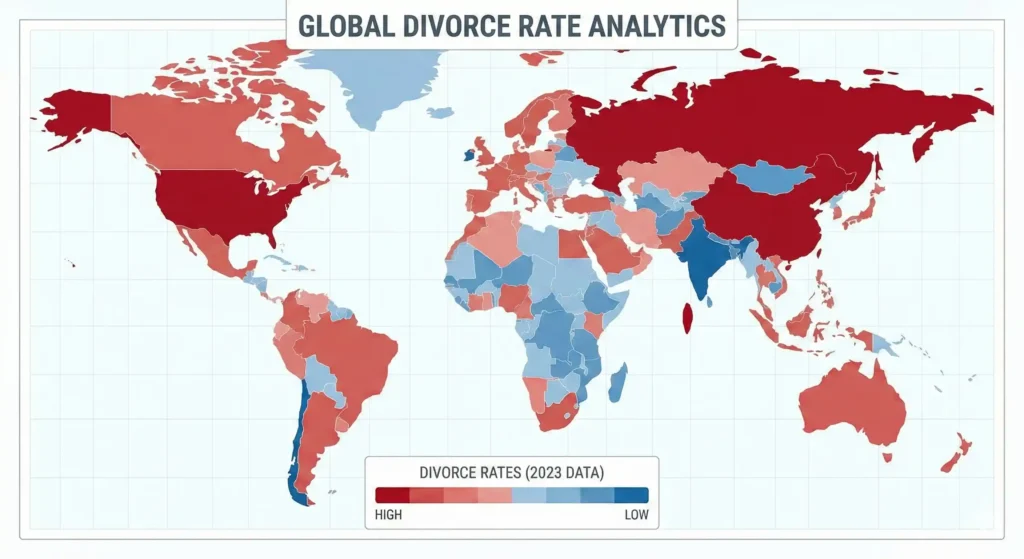
When we look at the data from the OECD (Organisation for Economic Co-operation and Development), the world is divided into two very different realities.
The “High-Divorce” Nations
You might expect the USA to be #1. You would be wrong.
The highest divorce rates (measured as the ratio of divorces to marriages in a given year) are often found in Europe and the former Soviet Union.
- Portugal (~94%): Yes, you read that right. For every 100 marriages, there are 94 divorces. (Note: This is inflated by older couples clearing a backlog, but the trend is undeniable).
- Spain (~85%): Cultural shifts and economic independence for women have transformed Spain from a conservative Catholic nation to a divorce capital.
- Russia (~73%): High rates of alcoholism, economic instability, and young marriage ages contribute to this massive number.
The “Low-Divorce” Nations
- India (<1%): This is often cited as a success story, but sociologists argue it reflects cultural stigma and lack of female financial independence rather than marital bliss. In many conservative societies, women stay because they cannot leave.
- Vietnam (~4%): Traditional Confucian values still hold strong, prioritizing the family unit over individual happiness.
The Insight: A low divorce rate does not equal a high happiness rate. Often, it just means “trapped.”
2. The “Marriage Paradox” in the West
Here is the twist: In the United States and the UK, divorce rates are actually dropping.
According to recent data, the divorce rate in the US has hit a 50-year low. Why?
Because Millennials and Gen Z are picky.
- The Selection Filter: Younger generations are waiting longer to get married (average age is now ~30 for men). They are living together first (cohabitation).
- The Result: By the time they actually say “I do,” they are financially stable and have vetted their partner thoroughly.
- The Paradox: Fewer people are getting married, but the ones who do are staying together longer. Marriage has shifted from a “Mandatory Rite of Passage” to a “Luxury Product” for the privileged and stable.
3. The Phenomenon of “Gray Divorce”
While young people are divorcing less, their parents are divorcing more.
Since 1990, the divorce rate for adults over 50 has doubled. This is known as the “Gray Divorce” revolution.
Why are Boomers splitting up?
- Longer Life Expectancy: At 60, you might have another 30 years to live. That is a long time to be miserable.
- The “Empty Nest” Syndrome: Once the kids leave, many couples realize they have nothing in common anymore. They were “co-parents,” not “partners.”
- Financial Independence: Women in this generation worked. They have their own 401(k)s. They don’t need to stay for survival.

4. The Economics of Heartbreak: Women’s Rights
The single strongest predictor of a country’s divorce rate is Women’s participation in the workforce.
When women earn their own money, divorce rates rise. This is a fact.
- The Traditional View: “Feminism destroyed the family.”
- The Sociological View: “Feminism allowed women to escape abusive or unhappy marriages.”
In countries where women are entering the workforce rapidly (like Brazil and China), we see a corresponding spike in divorce. It is the price of freedom. A relationship based on choice (I stay because I love you) is always healthier than a relationship based on need (I stay because I can’t afford rent).
5. The “Cooling Off” Controversy in Asia
While the West stabilizes, the East is facing a crisis.
China’s divorce rate surged so quickly that the government intervened.
The 30-Day Cooling-Off Rule:
In 2021, China implemented a law requiring couples to wait 30 days after filing for divorce. If either party changes their mind, the application is withdrawn.
- The Goal: To prevent impulsive divorces.
- The Reality: It has made it harder for victims of domestic violence to leave, sparking massive debate.
Similarly, South Korea and Japan are seeing a rise in “retired husband syndrome,” where wives divorce their husbands immediately after the husband retires, unwilling to cater to them 24/7.
6. The Psychology of “Self-Actualization” Marriage
Why do we divorce today? It’s not usually because of hunger or survival.
It’s because of Maslow’s Hierarchy of Needs.
- 1800s Marriage: “He helps me run the farm, and she doesn’t die in childbirth.” (Survival).
- 1950s Marriage: “He is a good provider, and she is a good mother.” (Role fulfillment).
- 2026 Marriage: “He must be my best friend, my passionate lover, my intellectual equal, and help me become the best version of myself.” (Self-Actualization).
We are asking one person to give us what an entire village used to provide. The expectations are higher than ever, so the disappointment is more frequent.
Are your expectations realistic? Sometimes we blame the relationship when we are actually struggling with our own compatibility. Check our Couple Compatibility Score to see if your foundational values match, or if you are chasing a fantasy.
7. The Impact of Laws and Technology
Two modern factors are silently tweaking the numbers:
1. No-Fault Divorce Laws
Historically, you had to prove “adultery” or “abuse” to get a divorce. Now, most Western nations allow “No-Fault” divorce (Irreconcilable Differences).
- Impact: It makes divorce easier and less traumatic, removing the need to drag a partner through the mud in court.
2. Dating Apps & The “Paradox of Choice”
Technology has created the illusion that “The One” is just one swipe away.
- The FOMO Effect: When marriage gets hard, people open Instagram or Tinder. The constant availability of potential alternatives makes people less willing to work through the boring, hard parts of a long-term commitment.
8. What Does This Mean for You?
The statistics are scary, but you are not a statistic.
Global trends show us that the definition of marriage is changing, not dying. We are moving from “Institutional Marriage” (duty) to “Intentional Marriage” (choice).
The Secret to Beating the Odds:
Research consistently shows that couples who stay together share three traits:
- Shared Meaning: They have a goal bigger than just “paying bills” (e.g., travel, faith, community).
- Repair Attempts: They know how to apologize quickly.
- Friendship: They genuinely like each other.

Frequently Asked Questions (FAQs)
Which country has the lowest divorce rate?
Statistically, India usually holds the lowest rate (under 1%). However, Sri Lanka and Guatemala also have extremely low rates. Keep in mind, low rates often correlate with strict religious laws or high costs of legal separation, not necessarily marital satisfaction.
Is the “50% of marriages end in divorce” stat true?
Not anymore. That statistic comes from the 1980s (the peak of the divorce boom). Today, in the US, the risk of divorce is closer to 39-42% and dropping for college-educated couples.
Does living together before marriage increase divorce risk?
This is the famous “Cohabitation Effect.” Older studies said yes. Newer studies (2020+) say no. The key factor isn’t living together; it’s the age you move in. Moving in at 19 increases risk. Moving in at 25 does not.
What is the #1 cause of divorce globally?
While “money fights” are common, the root cause is usually “Lack of Commitment” or “Growing Apart.” Infidelity is often a symptom of the drift, not the cause.
Are second marriages more successful?
Surprisingly, no. Second marriages have a divorce rate of roughly 60%, and third marriages are 73%. People often rush into remarriage without healing the trauma or fixing the behavioral patterns from the first divorce.
Conclusion: The Future of “I Do”
The global spike in divorce isn’t a sign that society is crumbling. It is a sign that society is evolving.
We are no longer accepting unhappiness as a lifestyle.
While the numbers can be daunting, they also offer hope. The marriages that survive today are stronger because they are chosen every single day—not out of obligation to the church or the state, but out of genuine connection.
So, don’t fear the statistics. Build a love that defies them.
Are you at a crossroads in your own relationship? Unsure if you should become part of the statistic or fight for love? Take our Should I Break Up? Quiz to gain clarity today.