We have all been there.
It starts with a dirty sock on the floor. Five minutes later, you are screaming about how your partner “never listens,” “doesn’t respect you,” and “ruined your birthday three years ago.”
You aren’t just fighting about the sock anymore. You are fighting for your emotional survival.
Most conflict resolution advice is terrible. “Just take a deep breath” or “use I-statements” sounds great in theory, but when your cortisol is spiking and your heart is racing, logic goes out the window.
At PairPulse, we don’t believe in generic advice. We believe in science.
In this deep-dive guide, we are going to look at the neuroscience of fighting. We will explore why your brain shuts down during an argument, the dangerous habit of “kitchen sinking,” and the specific 3-second brain hack that can stop a fight in its tracks.
1. The Neuroscience of “Flooding”: Why You Can’t Hear
Before we talk about techniques, you need to understand your biology.
Have you ever tried to reason with a drunk person? It’s impossible. Fighting with a “flooded” partner is the same thing.
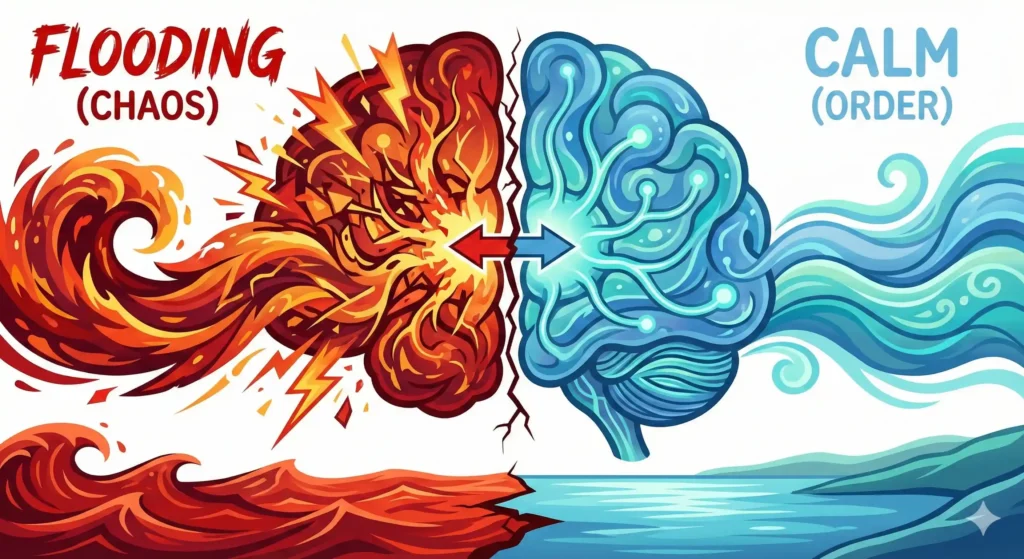
“Flooding” is a term coined by Dr. John Gottman. It happens when your heart rate exceeds 100 beats per minute during a conflict.
- The Amygdala (The Alarm System): Hijacks your brain. It screams DANGER!
- The Prefrontal Cortex (The Logic Center): Goes offline.
When your partner is flooded, they literally cannot hear you. They lose access to their empathy and problem-solving skills.
The Mistake: Trying to “finish the fight” right then.
The Fix: You need a biological reset, not a better argument.
The “20-Minute Vagus Nerve” Reset
The Vagus nerve controls your calming response. It takes about 20 minutes for it to flush the stress hormones from your body.
- The Script: “I am feeling flooded and I can’t be my best self right now. I need a 20-minute break. I promise I will come back to this at 7:30 PM.”
- The Rule: You must come back. If you don’t, your partner feels abandoned. If you do, they feel safe.
2. Stop “Kitchen Sinking”: The Fastest Way to Ruin a Relationship
Imagine you have a leak in your kitchen. Instead of fixing the leak, you decide to also fix the broken window, paint the walls, and re-tile the floor all at the same time.
What happens? The house floods.
In psychology, this is called “Kitchen Sinking”—dragging past grievances into a current argument.
- You: “Please put your dishes in the dishwasher.”
- Partner: “Oh yeah? Well, you forgot to pay the electric bill last month! And you were rude to my mother at Christmas!”
Why we do it: We hoard our hurts. We don’t bring them up when they happen, so they explode when we are angry.
The “One Problem” Rule
From now on, you are only allowed to discuss one issue at a time.
- If you are fighting about dishes, you cannot talk about money.
- If you are fighting about money, you cannot talk about his mother.
The Script: “I hear that you are upset about the electric bill, and that is important. But right now, we are talking about the dishes. Let’s solve the dishes first, and then we can talk about the bill.”
3. The “Temporal Lobe” Hack: The 3-Second Pause
Neuroscientists have found that the brain’s temporal lobe (which processes meaning) gets overwhelmed by the amygdala during shouting matches.
When your partner yells, your brain wants to yell back instantly. This is the Mirror Neuron effect.
The Technique:
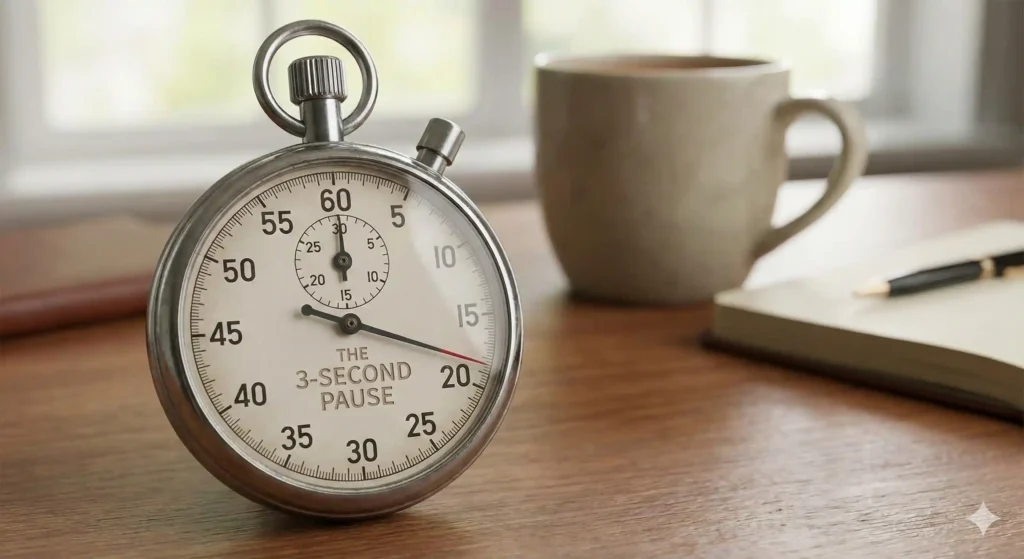
Force a 3-to-5 second silence after your partner finishes speaking.
- Count to three in your head: One Mississippi, Two Mississippi, Three Mississippi.
Why it works:
- It breaks the “rapid-fire” rhythm of the fight.
- It gives your prefrontal cortex a chance to catch up.
- It signals to your partner that you are thinking, not just reacting.
4. Validation vs. Agreement (They Are Not the Same)
This is the most common misconception in conflict resolution. You think, “If I validate his feelings, I am admitting I was wrong.”
False.
- Agreement: “You are right. I am a bad driver.”
- Validation: “I can see why you were scared when I braked hard. That must have been terrifying for you.”
You can validate someone’s emotion while completely disagreeing with their “facts.”
According to research from The Gottman Institute, validation is the “secret sauce” that lowers emotional defenses. Once a person feels heard, they stop fighting to be understood.
The “It Makes Sense” Script:
Even if you think they are being irrational, find the one tiny part of their logic that makes sense.
- “It makes sense that you are angry about me being late, because you were sitting here alone waiting for me.”(Notice: You didn’t say “I shouldn’t have been late.” You just validated their experience of waiting.)
5. Gottman’s “Repair Attempts”: The Emergency Brake
A “Repair Attempt” is any statement or action—silly or serious—that prevents negativity from escalating out of control.
Happy couples aren’t couples who don’t fight. They are couples who know how to repair during the fight.
Examples of Repair Scripts:
- “I’m feeling defensive. Can you say that again gently?”
- “I need to calm down. Can we pause?”
- “I’m sorry, I overreacted.”
- Reaching out and holding their hand.
If your partner tries to repair, you must accept it. Imagine they are driving a car off a cliff and they pull the handbrake. If you smack their hand away (by saying “Don’t touch me!”), you both go over the edge.
Pro Tip: Do you struggle to accept repair attempts? It might be a sign of deeper resentment. Take our Should I Break Up? Quiz to evaluate the current health of your bond.
6. The “XYZ” Formula: How to Complain Without Blaming
“You always” and “You never” are the two most dangerous phrases in the English language. They are character assassinations, not complaints.
Swap them for the XYZ Formula:
“When you do X, in situation Y, I feel Z.”
- Bad: “You are such a slob.” (Character attack)
- Good: “When you leave your wet towel on the bed (X), right after I changed the sheets (Y), I feel disrespected because it creates more work for me (Z).”
This focuses on the behavior, not the person. It is a problem to be solved, not a flaw to be shamed.
7. The “Aftermath” Ritual: Reconnecting After the Storm
The fight isn’t over when the yelling stops. It ends when the connection is restored.
Many couples go to sleep in cold silence. This creates “emotional residue” that builds up over years.
The “Do-Over” Technique:
Once you are both calm (maybe the next day), revisit the fight without the emotion.
- “What went wrong yesterday?”
- “I regret saying X.”
- “Next time, I will try to do Y.”
Sensory Anchoring:
End the resolution with physical touch. A 20-second hug releases oxytocin and signals to your mammalian brain that the “threat” is over.
Thinking Long Term? If you are wondering if your conflict styles are compatible for a lifetime, check our Couple Compatibility Score. It measures how well you navigate storms together.

Frequently Asked Questions (FAQs)
My partner refuses to talk. They just shut down (stonewalling). What do I do?
Stonewalling is usually a reaction to feeling overwhelmed. Stop chasing them. Give them space, but ask for a specific return time. “I see you need space. Let’s talk in one hour.” This reduces their anxiety about being trapped in the fight.
Is it okay to go to bed angry?
Yes! The old adage “never go to bed angry” is biologically wrong. Sleep resets your neurochemistry. Often, you will wake up realizing the fight wasn’t as big as it felt at 11 PM.
How do I stop crying when I’m angry?
Crying is a release of frustration, not weakness. However, if it stops you from speaking, try “Sensory Grounding.” Squeeze a stress ball, hold an ice cube, or feel the texture of the chair. This pulls your brain out of the emotional center and back into the physical reality.
Final Thoughts from Oliver
Conflict is not a sign that your relationship is failing. It is a sign that your relationship is alive. Even the happiest couples fight. The difference is that they fight for the relationship, not against each other.
Next time you feel the heat rising, remember: You are on the same team. The problem is the enemy, not your partner.
Are you unsure if your relationship is worth the constant conflict? Our Should I Marry Him/Her? Quiz can help you clarify your future.